Whether Generation Changes a Maltipoo’s Look
A Maltipoo’s generation can offer clues about its likely coat and overall look, but it cannot tell you exactly what an individual puppy will look like as an adult. F1, F1b, and multigenerational labels describe a dog’s ancestry—not a guaranteed curl pattern, color, face shape, or size. This guide explains what those labels can suggest, where they fall short, and what to look for instead.
What Maltipoo generations mean
Generation labels are shorthand for how a Maltipoo’s parents are related to Maltese and Poodles. They can help you understand a puppy’s background, but they are not a precise forecast of its appearance. Even puppies in the same litter can inherit noticeably different combinations of traits.
F1 Maltipoos
An F1 Maltipoo is usually the result of crossing a purebred Maltese with a purebred Poodle. The Poodle may be a Toy or Miniature Poodle, which can influence the puppy’s expected adult size, though it does not determine it by itself. The Maltese contributes its own inherited traits, including a small frame and a long, often silky coat.
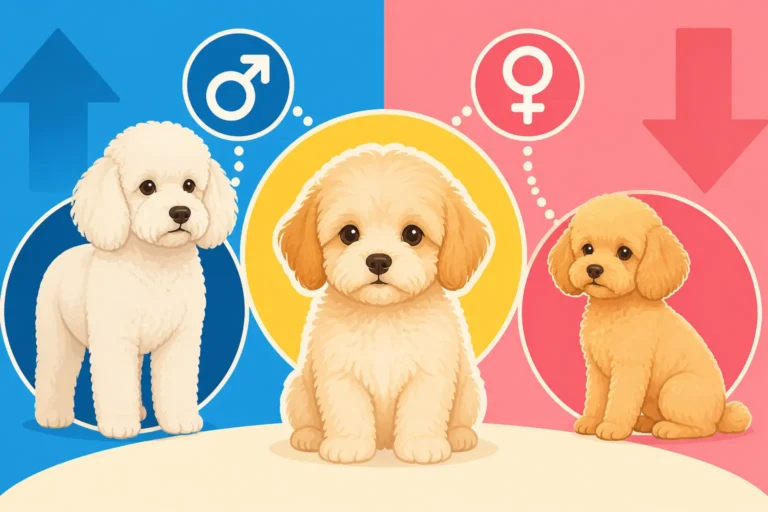
Because an F1 puppy receives a mix of genes from two different breeds, its appearance can vary. One puppy may have a looser, wavier coat, while a littermate may develop tighter curls. A puppy may look more Maltese in the face and coat texture, more Poodle-like, or somewhere in between. The label tells you about the parents’ breed backgrounds, not which particular traits a puppy received.
That variation is normal, not evidence that the breeder has misidentified the generation. If you want to understand why littermates can turn out so differently, see Whether Two Maltipoo Littermates Look Alike. A family may be hoping for one specific look—a teddy-bear face and soft waves, for example—but an F1 label cannot promise that combination.
F1b and multigenerational Maltipoos
An F1b Maltipoo is commonly a Maltipoo crossed back to a purebred Poodle, though breeders may use generation labels somewhat differently. This backcross increases the proportion of Poodle ancestry on paper. It can make some Poodle-associated traits, such as a curlier coat, more likely in a litter, but it does not make every puppy look or behave like a Poodle.
For a closer look at the expectations and limits of this label, read Whether an F1b Maltipoo Looks More Poodle. A curlier coat may be more common in an F1b litter, but coat type still depends on the genes inherited by each puppy. Some puppies may have looser waves, and other traits—such as muzzle shape, ear set, and coat color—can remain quite varied.
“Multigenerational” generally means the dog comes from several generations of Maltipoo breeding rather than a straightforward first-generation cross. The term does not, on its own, guarantee a uniform appearance. How consistent a litter is depends on the parents’ traits, their family histories, and the breeder’s selection practices. Ask the breeder to explain the exact parentage behind the label rather than relying on the word alone.
What generation can suggest about a Maltipoo’s appearance
A generation may offer a broad hint about the mix of ancestry, but appearance is made up of several separate traits. Coat texture, color, face shape, and body size are influenced by different inherited factors. A puppy that looks strongly like one parent in one respect may resemble the other parent in another.
Coat texture and curl
Coat texture is one of the features people most often try to predict from generation. Poodles are known for curly coats, while Maltese coats are typically long and silky. Maltipoos can inherit a range of textures between those examples, including straight, wavy, and curly coats. Generation can help frame a likelihood, but it cannot identify a puppy’s eventual texture with certainty.
A wavy puppy might develop a denser or curlier coat as it matures, while a coat that looks fairly straight in early puppyhood may change during the transition to an adult coat. Even then, the adult coat is not always easy to predict from a quick look at a young puppy. Photos of the parents and older relatives can provide context, but they are clues rather than guarantees. For examples of the range, see The Wavy Maltipoo Coat, The Curly Maltipoo Coat, and The Straight Coated Maltipoo.
Coat type also matters for day-to-day care, regardless of generation. A longer, curlier, or denser coat may tangle more readily if it is not brushed and combed regularly, particularly around the ears, collar, legs, and harness area. If you are putting together a grooming kit, retailers such as Chewy offer different kinds of brushes and combs; choose tools suited to the dog’s coat and ask a groomer or veterinarian if you are unsure what is appropriate.
Color, face, and size
Generation does not determine coat color. Maltipoos can be white, cream, apricot, black, brown, or combinations of colors, depending on the genes in their family lines. A puppy’s color can also change as it grows. A darker puppy may lighten, or its adult coat may become less intense than its puppy coat. The possibility of a change is not limited to one generation. Whether a Maltipoo's Color Lightens as It Ages explains why puppy color should not be treated as a permanent promise.
Face shape is similarly difficult to predict from generation alone. One puppy may have a shorter muzzle and rounder expression, while another from the same litter has a more elongated muzzle. Ears, eye shape, and the way the coat frames the face can also make two dogs look quite different, even if their ancestry labels match.
Size is affected by more than generation, too. The size of each parent, the Poodle variety involved, and the puppy’s broader family background all matter. A breeder may estimate adult size using parent weights and growth information, but should be cautious about promising an exact number. For more on that distinction, see Whether a Maltipoo Breeder Can Promise a Size. A generation label is not a reliable substitute for asking about the actual parents and relatives.
| Feature | What generation may suggest | What it cannot guarantee |
|---|---|---|
| Coat texture | A backcross to a Poodle may make Poodle-associated coat traits more likely | That every puppy will have tight curls or a particular texture |
| Color | The family line may carry a range of possible colors | A puppy will keep its exact puppy color as an adult |
| Face shape | Parentage may offer clues about the traits in the family | A specific muzzle, eye shape, or teddy-bear expression |
| Adult size | Parent sizes and ancestry can provide context | An exact adult weight based on the generation label alone |
| Litter consistency | Repeated breeding within a line may allow a breeder to track traits | That all puppies in a litter will look alike |
Why puppies from the same generation can look different
It is tempting to treat a generation label as if it were a recipe: choose the right label and receive a predictable look. In practice, inherited traits do not arrive as a matching set. Puppies from the same parents can receive different combinations of genes, which is why one litter may include a curly-coated puppy, a wavy-coated puppy, and one whose adult coat looks quite different from either sibling.
A generation is ancestry, not a visual grade
F1, F1b, and multigenerational labels describe breeding history. They are not rankings of appearance, and one label is not automatically better for a particular household. An F1b puppy is not guaranteed to be curlier, smaller, more hypoallergenic, or more uniform than an F1 puppy. A multigenerational dog is not automatically more predictable unless the breeder can explain the family’s traits and show how consistently those traits have appeared.
There is also no single universal way every breeder uses generation terminology. Before comparing two listings, ask what each parent is and how the breeder arrived at the label. If a seller uses “F1b,” for instance, ask whether the Maltipoo parent was crossed with a Poodle or whether the pairing was different. Clear answers matter more than the label by itself.
The same care is useful when comparing photos online. A picture may show a puppy at a particular age, under a particular haircut, lighting, and camera angle. A tidy trim can make a coat look rounder or fuller; a longer style may emphasize waves or curls. A photo does not reveal how the coat will develop or how much grooming it will need.
Coat development can change the picture
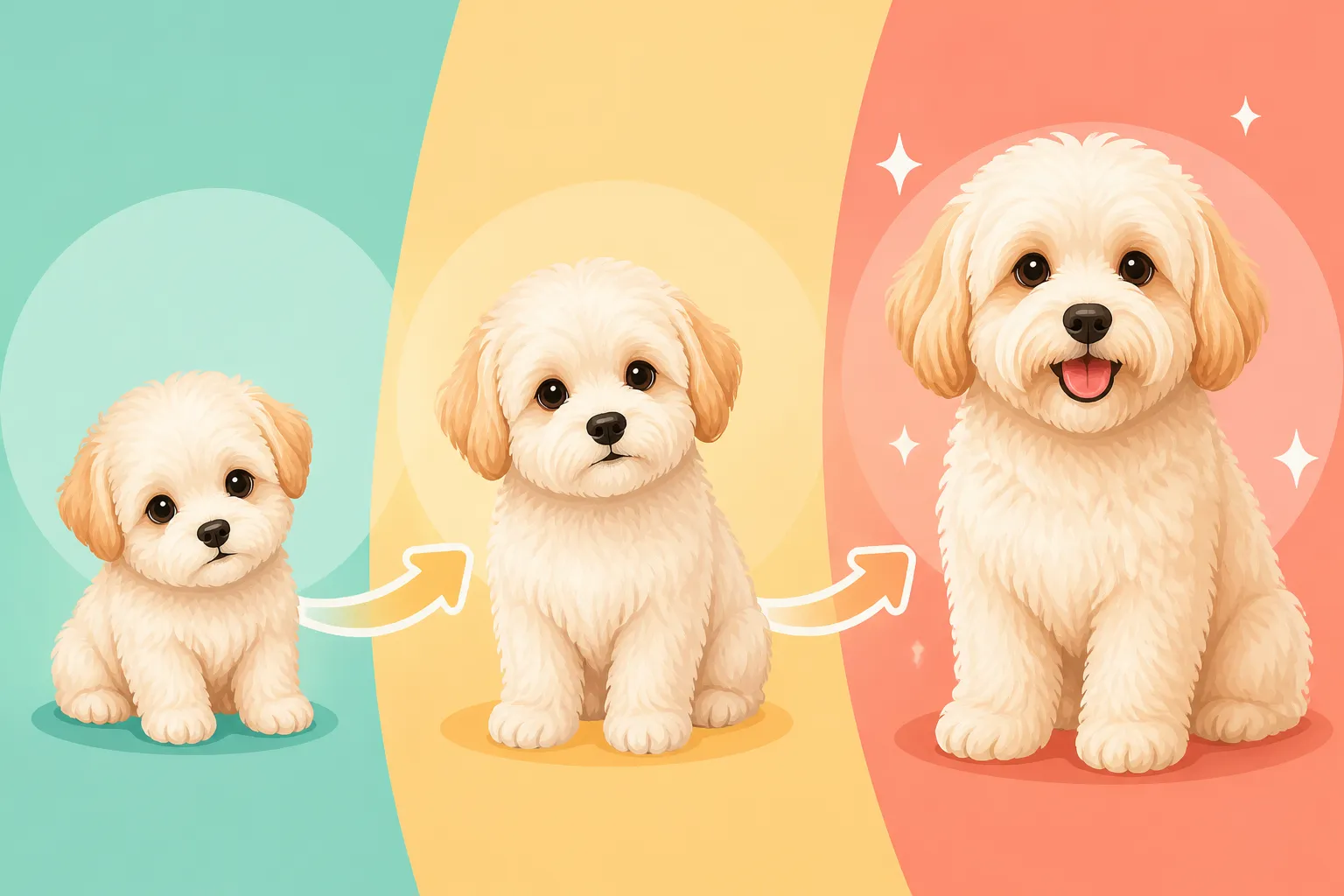
A Maltipoo puppy’s coat may change in length, density, and texture as it grows. Some changes happen gradually, while others become more noticeable as the puppy’s coat transitions toward its adult coat. A breeder’s experience with the parents and older dogs in the line can be useful, but it still cannot turn a prediction into certainty. For more on what puppy coat clues can and cannot tell you, read Whether a Maltipoo Puppy's Coat Tells You Anything.
It is reasonable to ask to see recent photos of the puppy’s parents and, if available, adult dogs from related litters. Look for patterns rather than expecting an exact match. If several relatives have similar coats, that gives you information about what has appeared in the family. It still does not prove that a particular puppy will inherit the same texture or color.
Even two mostly white parents may carry genes for other coat colors. A puppy’s appearance depends on the genes passed down from both sides of its family, including traits that may not be obvious in the parents. Whether Two White Maltipoos Throw a Colored Puppy explores why a shared visible color does not necessarily tell the whole genetic story.
How to judge a Maltipoo’s likely look more realistically
If appearance matters to you, focus on the individual puppy and the information behind it, rather than choosing solely by generation. A few thoughtful questions can help you set realistic expectations and avoid the disappointment of assuming that a label guarantees a particular adult look.
Questions to ask the breeder
Start by asking for a plain-language explanation of the parents and the generation label. Ask what type of Poodle was involved, how large both parents are, and what the breeder has observed in adult relatives. If the breeder has raised several litters from the same or closely related lines, ask what range of coat types and colors has appeared—not just which puppy looked most like the advertised ideal.
Ask how the breeder describes uncertainty. A responsible answer might explain that a certain coat type appears often in the family but cannot be guaranteed in every puppy. Be cautious if someone presents a generation label as proof that a puppy will have a particular coat, exact weight, or final color. Whether Maltipoo Demand Has Passed Its Peak is a separate topic, but the same general lesson applies to buying a popular cross: marketing language should not replace clear information about the individual dog.
Request photos that help you understand the puppy’s development and family background. Photos of adult relatives are more useful for adult appearance than a single staged puppy portrait. If you are meeting the litter in person, observe each puppy’s coat and facial features without assuming the smallest or curliest puppy will stay that way.
Match the expected care to your household
A particular look can come with practical responsibilities. A longer coat can be charming, but it may need frequent brushing and regular professional grooming to prevent tangles. A curly coat can be especially prone to matting if it is allowed to grow without consistent care. Ask what the breeder recommends for brushing and what grooming habits the puppy has already experienced.
If you need grooming supplies, Chewy is one place to compare basic options such as combs and coat brushes, but the right tool depends on the individual dog and its coat. A gentle comb that reaches through the coat without pulling is useful for checking whether the hair is tangled close to the skin. If a brush seems to snag or irritate the puppy, stop and ask a groomer for guidance rather than forcing it through.
Plan for the coat the dog actually develops, not the coat you were promised or hoped for. A puppy may become curlier, straighter, or a different shade than expected. That is one reason many owners find it helpful to discuss a manageable trim with a groomer early on. Chewy may also be a convenient place to look for everyday grooming items, but a product listing cannot replace advice tailored to a particular dog’s coat and skin.
Generation is useful background information, but the most realistic expectation comes from combining the puppy’s own features, its parents’ characteristics, its relatives’ history, and an understanding that growth can change the picture. If you are considering a Maltipoo, choose a puppy whose needs and likely grooming routine suit your life—not just one whose generation label sounds like a promise of a specific look.
Disclaimer
This article is for general informational purposes only and does not constitute professional advice. Laws, prices and regulations vary by location and change over time. Consult a qualified professional for guidance on your specific situation.