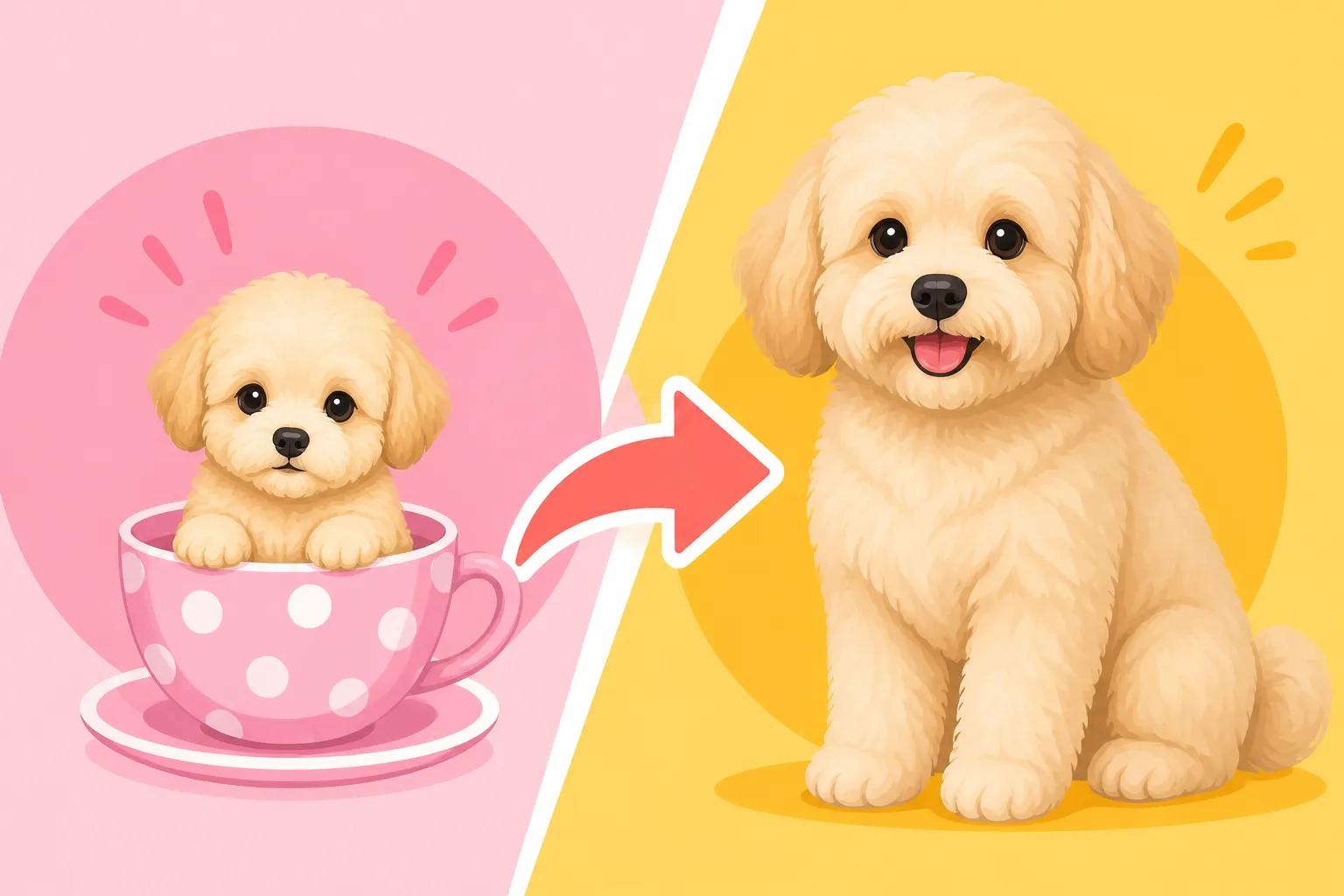
Whether a Maltipoo Sold as Teacup Grows Bigger
It's incredibly disheartening when you bring home what you believe is a tiny "teacup" Maltipoo, only for them to sprout up into a much larger dog than you anticipated. This isn't just about size; it's about the plans you've made, the gear you've bought, and sometimes, even the medical considerations. This guide will delve into the reality of the "teacup" Maltipoo label and help you understand why your pint-sized puppy might just grow bigger than expected, and what that truly means for their care.
The Allure and Illusion of the "Teacup" Label
The term "teacup" for a Maltipoo, or any dog for that matter, conjures images of an impossibly tiny companion that fits into your palm. It's a marketing term, plain and simple, and one that taps into the deep desire for the smallest, most delicate pet. Many hopeful owners envision a dog that can easily travel in a carrier or perch gracefully on a lap, perpetually puppy-sized. The reality, however, often proves to be quite different and can leave owners feeling confused or even misled when their tiny bundle starts to fill out.
The Unregulated World of "Teacup" Dogs
One of the biggest frustrations with the "teacup" designation is that it has absolutely no official recognition from any major kennel club or veterinary organization. There's no breed standard defining a "teacup" Maltipoo, no weight range, no height limit. This lack of regulation means that breeders can use the term at their discretion, often applying it to the smallest puppies in a litter, or even to runts, without any actual guarantee of their adult size. You might see a puppy advertised as "teacup" that simply happens to be smaller at eight weeks, but its genetic potential for growth hasn't been realized yet. It’s a marketing strategy designed to attract buyers looking for the smallest possible companion, and it often leads to unrealistic expectations. This ambiguity is why it's so important for prospective owners to understand that Whether Teacup Means Anything on a Maltipoo Medically is a crucial question to consider.
The True Sizes of Maltipoos
Instead of "teacup," which is largely subjective, Maltipoos generally fall into three recognized (though still not official, as Maltipoos are not a recognized breed) size categories: Toy, Miniature, and occasionally, Teacup in marketing. A Toy Maltipoo typically weighs between 5 and 10 pounds as an adult. A Miniature Maltipoo can range from 10 to 20 pounds. The true "teacup" sizes, often marketed as 2-5 pounds, are far less common and come with their own set of potential health challenges. When a breeder advertises a Maltipoo as "teacup," they are usually implying it will fall into the lower end of the Toy category, or perhaps even smaller. However, without knowing the full genetic background and parental sizes, it's a gamble. Sometimes, what breeders call "teacup" is simply a puppy that is underweight at the time of sale, or one that has inherited genes for a larger size but hasn't had the time to grow into them. Understanding The Three Maltipoo Sizes and Who Decides Them can help manage expectations.
Decoding Maltipoo Growth Patterns
Understanding how Maltipoos grow is key to anticipating their adult size. While there are some general guidelines, individual puppies can vary significantly. Owners often track their puppy’s weight eagerly, hoping it stays within that desirable "teacup" range, but a sudden growth spurt can quickly dash those hopes.
The Typical Growth Trajectory
Maltipoo puppies, much like children, grow rapidly in their first few months of life. Most of their significant growth happens between birth and around 6-8 months of age. By 9-12 months, many Maltipoos have reached their full adult height, though they might continue to fill out and gain a bit more weight or muscle mass until they are 18 months old. This means that a tiny 2-pound puppy at 8 weeks could easily reach 7-8 pounds by the time they are 6 months old. The crucial period for predicting adult size is often around 12-16 weeks. A common rule of thumb is to double a puppy's weight at 12 weeks to get a rough estimate of their adult weight, or sometimes add a pound. For example, a 2-pound Maltipoo puppy at 12 weeks could very well be a 4-5 pound adult, putting them out of the extreme "teacup" range. This is why a puppy's weight at a very young age is not a definitive indicator of their eventual size, especially if they are sold much younger than 12 weeks.
Factors Beyond the "Teacup" Label
Several factors beyond a breeder's label truly dictate a Maltipoo's adult size. The most significant are genetics, primarily the size of the parent dogs. If both parents are on the larger side of the Toy Poodle and Maltese spectrum, it’s highly improbable their offspring will remain under 5 pounds. Nutrition also plays a role; a well-fed puppy with a balanced diet like those offered by Ollie is more likely to reach its genetic growth potential than one that is underfed. Gender can also be a factor, with male Maltipoos sometimes growing slightly larger than females. Environment, general health, and even spaying/neutering (though less impactful on ultimate size, it can affect metabolism) all contribute to how a Maltipoo develops. It’s important to remember that a healthy growth trajectory is more important than achieving an arbitrary "teacup" weight. If you're wondering about predictability, it's worth reading up on Whether a Maltipoo Breeder Can Guarantee a Maltipoo's Weight.
The Influence of Parental Genetics on Size
Genetics are the ultimate blueprint for a Maltipoo's size. While an adorable little fluffball might melt your heart, their genetic heritage holds the real clues to how big they'll get. Disregarding parental size information is one of the most common pitfalls for prospective owners eager for a tiny dog.
The Role of the Maltese and Poodle Parents
The Maltipoo is a crossbreed, typically a mix of a Maltese and a Toy Poodle, or sometimes a Miniature Poodle for larger variations. Both the Maltese and the Toy Poodle are small breeds, but they still have a range. A full-grown Maltese usually weighs between 4-7 pounds, while a Toy Poodle can range from 4-10 pounds. If a Maltipoo puppy has parents on the higher end of these weight ranges, or even one parent that leans towards a larger Toy Poodle or a small Miniature Poodle, the puppy has a much higher chance of growing larger than the "teacup" ideal of under 5 pounds. It’s common for people to overlook the potential size variation within these parent breeds. For example, a 9-pound Toy Poodle parent and a 7-pound Maltese parent will very likely produce offspring that mature to 6-9 pounds, well outside the tiny "teacup" range. This highlights why understanding The Maltese and the Poodle Behind Every Maltipoo is fundamental.
Predicting Adult Weight: What to Look For
To get the most accurate estimate of your Maltipoo's adult size, look at the weight of both parents. A reputable breeder will be transparent about the size of the sire and dam and ideally even previous offspring if available. Ask to see the parents in person or via video call if possible. If a breeder is evasive about parent sizes or only shows you one parent, it's a red flag. As mentioned earlier, a common calculation involves doubling the puppy's weight at 12 weeks, but even this is just an estimate. Another approach is to multiply their weight at 16 weeks by two to get a slightly more accurate prediction of their full adult size. However, even with all these methods, there can be surprises. Sometimes, a puppy simply inherits a growth gene from an earlier generation, or perhaps the 'runt' of the litter catches up later. For more detailed information on growth, you can check out The Age Each Maltipoo Size Finishes Growing.
Here's a quick reference table for general Maltipoo growth expectations:
| Age of Puppy | Expected Weight Range (Typical) | "Teacup" Buyer Expectation | Potential Adult Weight (Estimate) |
|---|---|---|---|
| 8 Weeks | 1.5 – 3 lbs | Under 2 lbs | 4 – 8 lbs |
| 12 Weeks | 2 – 4.5 lbs | Under 3 lbs | 4.5 – 9 lbs |
| 16 Weeks | 3 – 6 lbs | Under 4 lbs | 6 – 12 lbs |
| 6 Months | 4 – 9 lbs | Under 5 lbs | Near Adult Size |
| 9-12 Months | Full Adult Weight | Under 5 lbs | Final Adult Weight |
Note: These are general ranges. Individual puppies may vary significantly.
The Health Implications of "Teacup" Sizing
Beyond the aesthetic desire for a tiny dog, the pursuit of extremely small "teacup" sizes can carry significant health risks. While a slightly larger Maltipoo might be a surprise, an unnaturally small one can be a cause for serious concern and higher vet bills. This is a critical point that many prospective owners don't fully grasp until they're facing an emergency.
The Risks Associated with Tiny Stature
Maltipoos intentionally bred to be exceptionally small often face a host of health problems. These can include fragile bones prone to fractures, making seemingly innocent tumbles off a sofa a serious danger. They are also highly susceptible to hypoglycemia (low blood sugar), which can be life-threatening, especially in puppies, and requires vigilant feeding schedules and emergency care. Conditions like hydrocephalus (water on the brain), liver shunts, and collapsing tracheas are also more prevalent in these extremely small dogs. Their tiny bodies struggle to regulate temperature effectively, making them prone to chills even indoors. Owners should be aware that What Breeding Smaller Costs a Maltipoo goes far beyond the initial purchase price. Unexpected health issues can lead to substantial veterinary costs, making pet insurance providers like Healthy Paws a very wise investment for Maltipoo owners.
When Your "Teacup" Outgrows Its Label
If your Maltipoo grows larger than the "teacup" size you expected, it's often a blessing in disguise for their health. A dog that matures to a healthy 6-10 pounds, rather than staying under 5 pounds, generally has a more robust constitution. They are less prone to accidental injuries, less susceptible to temperature fluctuations, and often have a more developed immune system. While the initial disappointment of not having a "teacup" is understandable, embracing their healthy growth means a sturdier companion with potentially fewer complex medical issues. It simply means you might need a slightly larger carrier from Chewy and more substantial toys! Instead of lamenting the size, focus on celebrating their vitality. For those concerned about the impact of larger size, it's worth reviewing Whether a Two Pound Maltipoo Is Healthy to understand the full picture.
Avoiding Disappointment and Finding the Right Maltipoo
The best way to avoid the disappointment of a "teacup" Maltipoo growing bigger than anticipated is to manage your expectations from the outset and prioritize health over an arbitrary size label. Being an informed buyer is your greatest defense.
What to Ask a Breeder
When looking for a Maltipoo, especially if you have a strong preference for size, engage with breeders who are transparent and prioritize the health and well-being of their dogs. Always ask about the full-grown weights of both parent dogs. Request to see photos or, even better, meet the parents. Inquire about the puppy’s current weight and projected adult weight, but understand that these are always estimates. A responsible breeder will focus on healthy lineage rather than selling an impossible "teacup" dream. They should also provide health clearances for the parent dogs, including patella checks and eye certifications, as these are common concerns for small breeds. Don't be shy about asking for references from previous puppy buyers. It’s also crucial to ask The Four Certificates a Maltipoo Breeder Should Show to ensure you're dealing with a reputable source.
Embracing the Maltipoo You Get
Ultimately, the most important thing is to love and care for the Maltipoo you bring into your home, regardless of their final size. Whether they stay a tiny 4 pounds or grow to a robust 10 pounds, their personality, affection, and unique charm will be what truly enrich your life. A slightly larger Maltipoo may even be more resilient and capable of enjoying activities that an extremely delicate "teacup" might struggle with, like longer walks or playing with children. Focus on providing excellent nutrition, consistent training, and preventative veterinary care, and you’ll have a happy, healthy companion for many years. Remember, What You Pay for a Smaller Maltipoo and What It Costs Later is a significant factor, and sometimes, a slightly larger, healthier dog is the most cost-effective and emotionally rewarding choice in the long run.
Disclaimer
This article is for general informational purposes only and does not constitute professional advice. Laws, prices and regulations vary by location and change over time. Consult a qualified professional for guidance on your specific situation.