Whether the Maltipoo Was Bred to Be Small
A Maltipoo’s small size is not an accident: the mix usually combines a Maltese with a Toy Poodle, and breeders often aim for a compact companion dog. But “small” does not mean a guaranteed adult weight, and labels such as “teacup” do not describe a universally recognized size. This guide explains what breeders can influence, what they cannot promise, and why health should matter more than the tiniest possible puppy.
Are Maltipoos deliberately bred to be small
Smallness is part of the mix, but not a precise specification
Maltipoos are crosses between Maltese and Poodles. Because Maltese are small dogs and many Maltipoos have a Toy Poodle parent, a compact adult size is an expected outcome. Breeders may deliberately choose small parent dogs when they want puppies suited to apartment living or life as close-at-hand companions.
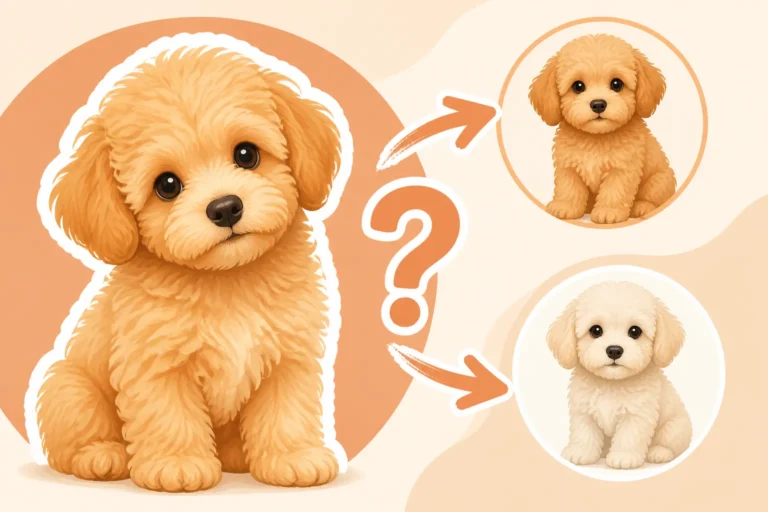
That is different from breeding toward one exact weight. A Maltipoo is not a standardized purebred with a single accepted size range, and puppies from the same litter can grow differently. A breeder can make an informed estimate from the parents and relatives, but cannot reliably dictate every puppy’s adult weight. For a closer look at the parent breeds, see The Maltese and the Poodle Behind Every Maltipoo.
“Bred to be small” also has more than one meaning. It might simply mean crossing two small companion breeds. Or it might mean choosing progressively smaller parents in an effort to produce exceptionally tiny puppies. Those approaches are not interchangeable: the first aims for a small dog, while the second can put excessive emphasis on size at the expense of health and sound breeding decisions.
The purpose is companion size, not a guaranteed tiny dog
Maltipoos are generally bred as companion dogs. Their small stature is one of the qualities many families seek, along with a sociable temperament and a coat that may be wavy or curly. But no cross guarantees a particular personality, coat, or adult build. Puppies can inherit different combinations of traits from each parent, even within one litter.
There is no single official Maltipoo standard that says every dog must fit a set height or weight. That is why discussions of “toy,” “miniature,” or “teacup” can be confusing: sellers may use these words differently, and they do not provide the same certainty as a standardized size classification. For more background on the mix’s companion-dog role, see What the Maltipoo Was Bred to Be.
It helps to separate a breeder’s goal from the puppy’s eventual body. A breeder may be aiming for a smaller companion dog, but genetics, early growth, and the size of the parent dogs all influence the result. A puppy that grows larger than a buyer expected is not necessarily evidence that the breeder intentionally misled them; what matters is whether the estimate was presented honestly and without a guarantee the breeder could not support.
What determines how small a Maltipoo will be
Parent size is useful evidence, not a promise
The size of both parents gives a buyer a sensible starting point. A Maltipoo with a Toy Poodle parent may be expected to remain smaller than one with a larger Poodle parent, but puppies inherit traits from both sides of the cross. Even two small parents can produce puppies that vary in weight and frame.
A breeder who has records for previous litters may be able to discuss the range those dogs reached as adults. That can be more informative than a confident-sounding prediction based only on a puppy’s current size. Ask what the breeder knows about adult relatives, how old the puppies were when past estimates were made, and whether the figures are actual adult weights or informal guesses.
Paw size, a puppy’s appearance, or one early weigh-in should not be treated as a dependable forecast. Growth changes over time, and a very young puppy’s current weight does not establish how small it will be as an adult. For more on how parent dogs factor into the outcome, see Whether the Poodle Parent Decides a Maltipoo's Size and Whether a Maltipoo Breeder Can Promise a Weight.
“Teacup” is not a separate, reliable size guarantee
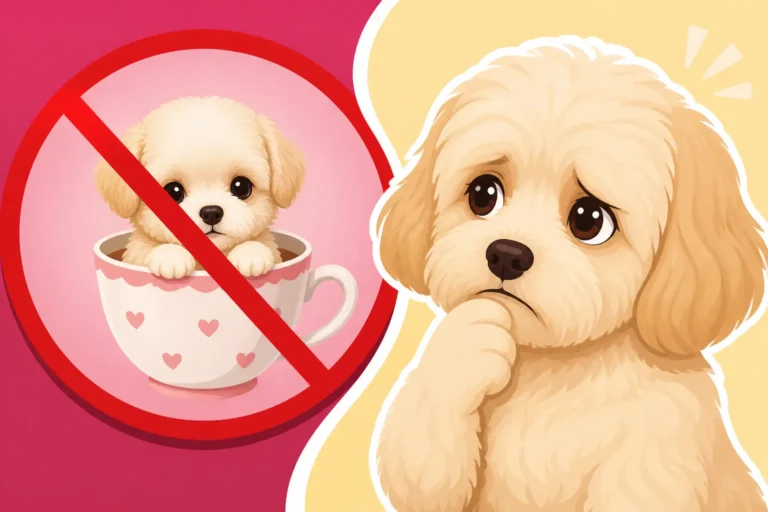
The label “teacup” can suggest a smaller-than-usual dog, but it is not a universally standardized Maltipoo size. One seller may use it to describe a particularly small puppy; another may attach it to a predicted adult weight. The label itself does not tell you how the puppy was bred, what health checks were done, or whether the adult-size estimate is dependable.
A very small puppy may simply be young, may remain small, or may grow beyond the seller’s prediction. Buyers should be cautious when an advertisement presents a label as if it settles those questions. Ask for the puppy’s age, current growth information, the parents’ adult sizes, and the breeder’s basis for estimating adult weight. Read the written agreement carefully to see what it actually says if the dog grows larger than anticipated.
The term can also blur the difference between a small dog and a dog bred toward extreme smallness. If an advertisement focuses much more on tiny size than on parent health, temperament, veterinary care, and the breeder’s practices, slow down and ask more questions. Whether Teacup Maltipoo Is a Marketing Word and Whether a Teacup Maltipoo Is a Deliberate Breeding explain why the label deserves scrutiny.
| What a buyer sees | What it can reasonably indicate | What it cannot guarantee |
|---|---|---|
| Two small parent dogs | A smaller adult size may be more likely | The puppy’s exact adult weight |
| A Toy Poodle parent | The Poodle parent is from a small size category | That every puppy will stay within a narrow range |
| A puppy described as “teacup” | The seller is marketing the puppy as especially small | A recognized size category, sound health, or a fixed adult size |
| Adult weights from related dogs | Useful context about the breeder’s past litters | That a new puppy will match those relatives |
When the drive for smaller size becomes a concern
Breeding for the smallest puppy can overshadow health
It is reasonable for a breeder to prefer small parent dogs when producing a small companion cross. Concern grows when the central objective becomes making each generation smaller, regardless of the health or welfare of the dogs involved. A tiny puppy is not automatically unhealthy, but extreme smallness should not be treated as a selling point that outweighs careful breeding and veterinary attention.
Ask how the breeder selects parent dogs beyond their size. A responsible conversation should include health history, veterinary care, temperament, and the breeder’s willingness to explain what is known and what remains uncertain. Be wary of pressure to reserve quickly, claims that a particular puppy will definitely stay below a precise weight, or answers that focus on appearance while avoiding questions about health.
A breeder should also be able to explain why a pairing makes sense and how the adult dogs are cared for. If the only explanation is that two especially tiny dogs were chosen to make puppies even tinier, ask more questions before committing. See Whether Breeding Two Small Maltipoos Is Safe for a related discussion of why size alone is not a sound breeding plan.
A healthy small dog is a better goal than the smallest possible dog
For a future owner, the useful question is not simply, “Which puppy will be tiniest?” It is, “Which breeder is making thoughtful choices and giving me a realistic picture of this puppy?” A dog with a somewhat larger adult frame may be a better match than a smaller puppy whose background, care, or health information is unclear.
A smaller dog may also require more attentive day-to-day handling. Puppies and adults can be vulnerable to accidental falls, rough play, or being stepped on in a busy household. Families with young children should plan close supervision and teach children how to interact gently rather than assuming that a small dog will automatically be easy to handle. For a broader comparison, see Whether a Bigger Maltipoo Is the Safer Buy.
If a breeder’s estimate is important to your plans, ask for it in writing and treat it as an estimate unless the contract clearly says otherwise. A written estimate can help set expectations, but it cannot change the biology of growth. The more specific and absolute the promise sounds, the more important it is to ask how the breeder arrived at it and what the agreement actually guarantees.
Choosing a Maltipoo without relying on size labels
Questions to ask before reserving a puppy
A careful conversation can reveal more than a listing headline. Ask about the adult weights and general health of both parents, whether the breeder has information on adult dogs from previous litters, and how the breeder describes the uncertainty around puppy growth. Listen for clear answers rather than a sales pitch built around a guaranteed weight.
You can also ask what the breeder means by “toy,” “miniature,” or “teacup.” Because those words may be used inconsistently for Maltipoos, ask for the actual information behind the label: parent sizes, the puppy’s age and growth history, and the reason for the adult-size estimate. The Three Maltipoo Sizes and Who Decides Them article offers more context on size descriptions.
Finally, ask what health information is available for the parent dogs and what veterinary care the puppies have received. A trustworthy breeder should be willing to discuss limitations as well as strengths. If a seller avoids ordinary questions, insists that the puppy’s size is certain, or pushes for a quick payment before you can review the details, it is sensible to step back.
Prepare for the dog you bring home, not the label
Before the puppy arrives, plan for a small dog while remaining open to some variation in adult size. Make the home safe: block access to risky jumps, set up a comfortable resting area, and decide how children and visitors will handle the puppy. These precautions are useful regardless of whether the adult dog ends up at the lower or higher end of the breeder’s estimate.
For supplies, prioritize fit and function rather than buying everything labeled for a particular Maltipoo size. A harness should fit securely as the puppy grows, and food portions should follow the food’s feeding guidance and your veterinarian’s advice rather than an assumed adult weight. When comparing small-breed food or basic supplies at Chewy, treat product descriptions as shopping information, not as evidence that a puppy will remain a certain size.
As the puppy matures, reassess what fits. A collar, harness, carrier, or bed bought for a tiny puppy may need replacing as the dog grows. Chewy and other retailers can be places to compare product dimensions and care instructions, but the breeder’s marketing label should not determine your dog’s feeding plan or veterinary care. If you are unsure whether a particular food or piece of equipment suits your puppy, ask your veterinarian.
The practical answer is straightforward: Maltipoos are often bred with small companion-dog size in mind because both sides of the cross are small, especially when the Poodle parent is a Toy Poodle. But “bred to be small” does not mean every puppy will be tiny, and no label can guarantee a precise adult weight. Look for responsible breeding, honest estimates, and a healthy dog—not the smallest number in an advertisement. Chewy may help you compare everyday supplies, but a retailer’s product categories cannot verify a breeder’s size claims.
Disclaimer
This article is for general informational purposes only and does not constitute professional advice. Laws, prices and regulations vary by location and change over time. Consult a qualified professional for guidance on your specific situation.