Whether a Maltipoo Is Too Fragile for a Toddler
It’s a truly heartwarming thought, isn't it? Bringing a fluffy, playful Maltipoo into a home where a curious toddler is already exploring the world. You dream of those sweet moments: your little one gently petting the soft fur, the dog offering a comforting presence. But then, a wave of very real concern washes over you. These tiny dogs feel so delicate in your hands, and toddlers… well, they aren’t known for their gentle touch. You’re worried, and rightly so, about whether a Maltipoo is simply too fragile to safely navigate the exuberant, unpredictable energy of a young child. This guide is here to walk you through that exact dilemma, offering realistic insights and practical steps to ensure safety for both your beloved pet and your precious child.
Understanding the Maltipoo's Delicate Nature
Let's start by being honest about the Maltipoo. They are absolutely adorable, and that's a huge part of their charm. But their small size and specific breed characteristics, inherited from both the Maltese and the Poodle, mean they come with some inherent physical vulnerabilities that you simply cannot ignore, especially when you have a toddler in the house. This isn't about being overly cautious; it's about being realistic and protective.
Their Physical Vulnerabilities
A Maltipoo isn't built like a sturdy Labrador. Their bones are finer, their bodies are compact, and certain joints can be prone to issues. When you look at a tiny Maltipoo, you're looking at a dog that can easily be injured by an accidental fall or rough handling. A seemingly minor bump for a larger dog could mean a serious injury for a Maltipoo.
Many small breeds, including Maltipoos, can be prone to conditions like Slipping Kneecaps in a Maltipoo, medically known as Patellar Luxation. This is where the kneecap slips out of place. Imagine a toddler, full of innocent enthusiasm, accidentally grabbing a leg or stepping on it. Even a small amount of pressure or an awkward twist could aggravate such a condition or even cause a fracture.
Beyond the bones, some Maltipoo puppies can even have an Whether an Open Fontanel Closes in a Maltipoo, a soft spot on their skull that hasn't fully fused. While this often closes as they mature, in very young puppies or those with persistent fontanelles, a knock to the head could be catastrophic. This is why you often hear dire warnings about small dogs and falls – it’s not an exaggeration. Even jumping off a sofa can cause significant injury for them, let alone an unintended drop by a child.
Behavioral Sensitivity
It's not just physical fragility; Maltipoos can also be quite sensitive emotionally and behaviorally. While they are often very affectionate and eager to please, their small size can make them feel vulnerable in a world dominated by much larger beings. A sudden loud noise, an abrupt movement, or an ungentle grab can be very startling for them.
This isn't to say Maltipoos are inherently fearful, but rather that their responses can be amplified by their size. A large dog might just absorb a loud bang, but a Maltipoo might jump, yelp, or try to bolt. If they feel trapped or threatened by a child's unpredictable movements, their natural instinct might be to try and escape, or in some cases, if they feel cornered and genuinely scared, they might even nip as a defensive measure. It's not out of malice, but pure fear, which is a situation no one wants to find themselves in. This sensitivity means that consistent, calm, and predictable interactions are key, which can be a tall order for a toddler.
Toddler Behavior and Unintentional Risks
Now, let's talk about toddlers. They are bundles of joy and curiosity, constantly learning and pushing boundaries. Their actions, while rarely malicious, often pose the greatest risk to a small, fragile dog like a Maltipoo. It's crucial to understand their developmental stage to properly assess the challenges.
The Nature of Toddlers
Toddlers (roughly ages 1-3 years old) are in a whirlwind of physical and cognitive development. Their gross motor skills are improving rapidly – they can walk, run, climb, and jump – but their fine motor skills are still quite clumsy. This means they might reach for a dog, but their grip could be too tight, their movements jerky, and their sense of how much pressure is "gentle" is still developing. They often haven't fully grasped cause and effect either. They might understand "gentle hands" in theory, but in the heat of the moment, with a wiggling, fluffy creature in front of them, those lessons can quickly go out the window.
Furthermore, toddlers are incredibly curious. They learn by touching, exploring, and often, by putting things in their mouths. A Maltipoo's long, silky ears or fluffy tail might look like a toy to a toddler. They don't understand that pulling an ear can be painful or that a tail isn't a handle. Their empathy is still nascent; they simply don't have the capacity to truly understand pain in another living being in the same way an older child or adult does.
Common Scenarios of Concern
Let's paint a picture of some common, yet dangerous, scenarios. These aren't far-fetched; they're the realities many families with small dogs and young children face:
- The Overzealous Hug: A toddler's embrace often lacks nuance. They might wrap their arms around a Maltipoo with all their might, squeezing too tightly, potentially injuring the dog's ribs or internal organs. The dog, startled and in pain, might instinctively struggle or even snap.
- The Accidental Drop: Many toddlers love to pick things up. They might try to lift a Maltipoo, only to lose their grip and drop the dog from a height. Even a short fall can result in broken bones for a dog as small as a Maltipoo. Whether a Maltipoo Can Be Injured by a Fall is a genuine concern, and a toddler's unsteady hands amplify this risk.
- Stepping or Tripping: A Maltipoo, being so small and light, can easily dart underfoot. A toddler, focused on a toy or running across the room, might accidentally step on the dog, causing severe injury. The dog might also trip the toddler, leading to injury for both.
- Toy Misuse: A toddler might accidentally hit the dog with a hard toy, or even throw something in their direction that causes a painful blow.
- The Tail Pull: A Maltipoo's plume-like tail can be an irresistible target for a curious toddler. Pulling it can cause significant pain and potentially damage the tail's delicate vertebrae.
These scenarios highlight that the risk isn't about a toddler being "mean," but about their natural developmental stage intersecting with a very vulnerable animal. The burden of safety falls entirely on the adults in the home.
Strategies for a Safe Coexistence
Given the inherent risks, creating a safe environment where a Maltipoo and a toddler can coexist requires deliberate, consistent effort and a proactive approach. It's not about hoping for the best; it's about actively managing the interactions.
Supervision is Non-Negotiable
This is the golden rule, and it truly cannot be stressed enough: never, ever leave a Maltipoo and a toddler unsupervised together. Not for a second. Even if you just step out of the room "for a moment," that moment is all it takes for an accident to happen. Active supervision means you are in the same room, actively observing their interaction, and ready to intervene instantly. Your presence allows you to anticipate potential issues before they escalate.
Think of it like this: your toddler needs constant supervision for their own safety, and your Maltipoo needs it even more so for theirs in this specific dynamic. If you can't actively supervise, you need to separate them. This isn't just about preventing physical harm; it's also about building positive associations between the child and the dog under controlled conditions.
Creating Safe Spaces
Both your Maltipoo and your toddler need designated safe zones where they can retreat and be free from each other's presence. This is vital for the dog's mental well-being and the child's safety.
- For the Maltipoo: A comfortable dog crate or a playpen can serve as their sanctuary. Place it in a quiet corner where they can see what's going on but are safely out of reach. Teach your Maltipoo that this is their special den, a place where they can go to relax without being bothered. You can find a wide variety of sturdy baby gates and pet playpens on platforms like Amazon that can help you create these physical barriers effectively. Make sure it's big enough for them to stand, turn around, and lie down comfortably.
- For the Toddler: Use baby gates to section off areas of your home. This allows your toddler to play freely in one zone while the Maltipoo can roam safely in another, or vice versa. This is especially helpful during meal times, nap times, or when you simply need a moment to focus on something else without worrying about an interaction.
Establishing these clear boundaries helps both child and dog understand where they are allowed to be and when. It also teaches the toddler that the dog's space is sacred, fostering respect.
Teaching Gentle Interaction
Starting early and being consistent with teaching your child how to interact with the dog is paramount. It’s an ongoing lesson that evolves as your child grows.
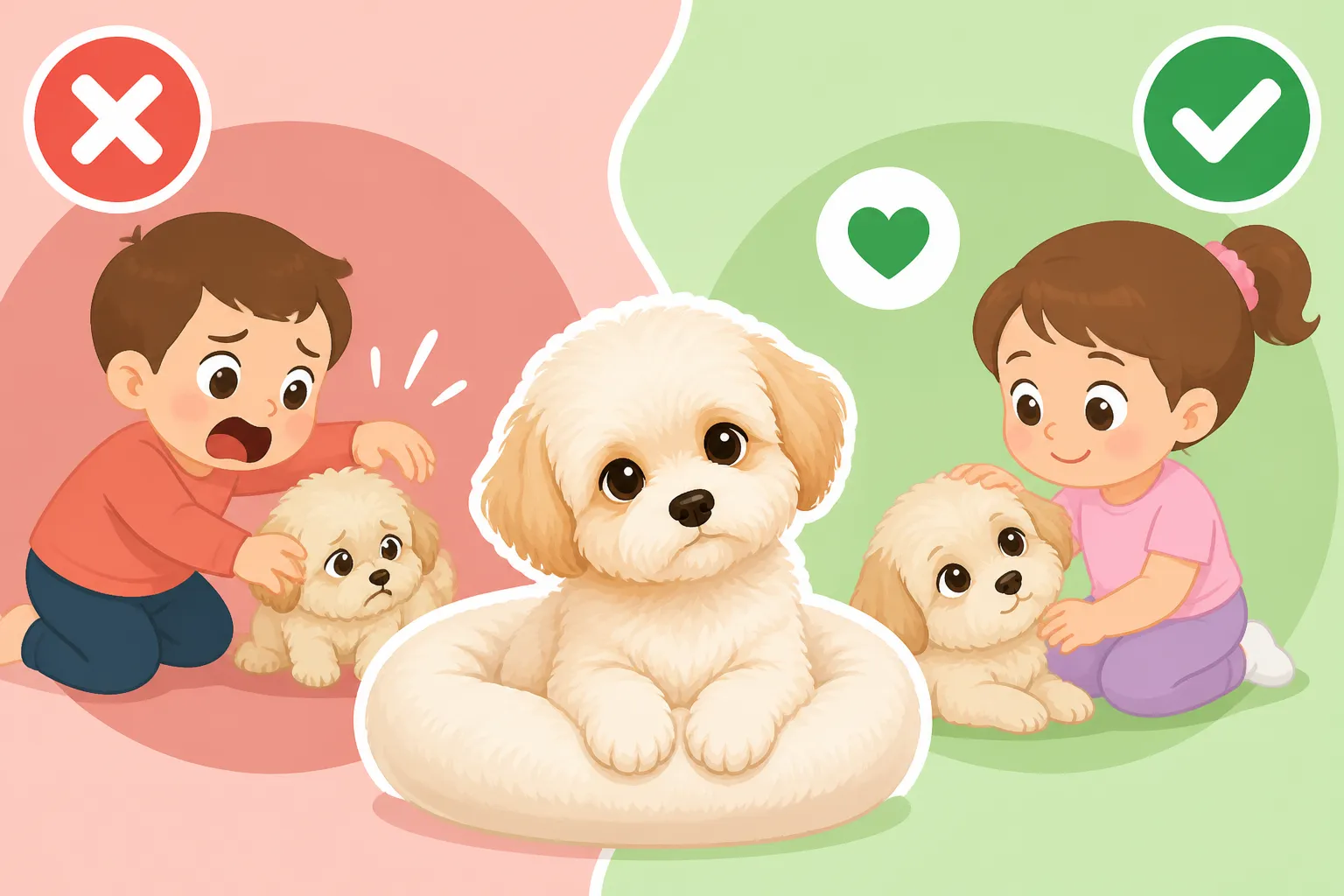
- Demonstrate, Don't Just Tell: Saying "be gentle" isn't enough for a toddler. Show them. Take their hand and gently stroke the dog's back with it. Narrate what you're doing: "Soft strokes, like this." Avoid letting them grab, poke, or pull. This also applies to Teaching a Child Where to Support a Maltipoo if they are old enough to be taught to hold the dog. Emphasize supporting the dog's body, never just picking them up by the scruff or legs.
- Controlled "Petting Sessions": Supervise very short, positive interactions. Sit on the floor with both the dog and the child. Allow the child to offer a treat (if appropriate for the dog's diet and your training), under your direct supervision, to create a positive association. End the session before either party gets overwhelmed.
- Respect the Dog's Signals: Teach your child to recognize when the Maltipoo needs space. If the dog yawns, licks its lips, turns its head away, or tries to move away, these are all signs of discomfort. Explain to your child, "Maltipoo needs a break now," and gently guide your child away or move the dog to its safe space. It’s vital for the Maltipoo to feel like they have an escape route and that their signals are understood.
Training Your Maltipoo for Children
It's not just the child who needs training; your Maltipoo benefits immensely from specific training to prepare them for life with a toddler. This involves positive reinforcement and desensitization.
- "Place" Command: Teach your Maltipoo a strong "place" command, where they go to a specific bed or mat and stay there until released. This is incredibly useful for when your child is active or when you need the dog to be out of the way for a short period. Reward heavily for staying on their place.
- Desensitization to Noise and Movement: Toddlers are loud and unpredictable. Gradually expose your Maltipoo to common toddler sounds (squeaky toys, cries, laughter) and movements from a safe distance, pairing them with positive experiences like treats. This can help them become more accustomed to the chaos without becoming fearful or reactive.
- Handling Drills: Because Maltipoos will be handled by vets, groomers, and occasionally family, practice handling their paws, ears, and mouth gently, rewarding them for tolerance. This can make accidental rough handling less startling, though it's not a substitute for gentle interaction. Consider online training programs like those offered by BAXTER & Bella, which often include modules on preparing your dog for family life and handling. They offer comprehensive, step-by-step guidance on positive reinforcement methods.
It's also important to remember that puppies are particularly vulnerable, both physically and behaviorally. Bringing a puppy home at eight weeks is a critical decision, as very young puppies are still learning bite inhibition and social cues from their littermates. Introducing a tiny, young puppy to an unpredictable toddler can be a recipe for disaster.
When to Reconsider or Seek Professional Help
Despite your best efforts, sometimes the combination of a tiny, sensitive dog and a boisterous, developing toddler just doesn't work. Recognizing these signs and knowing when to seek additional help or make difficult decisions is part of responsible pet and child ownership.
Signs the Pairing Isn't Working
It's heartbreaking to admit, but some pairings are simply not safe or fair to either the dog or the child. Look for these red flags:
- Persistent Anxiety in the Dog: Is your Maltipoo constantly hiding, trembling, or trying to escape whenever the toddler is around? Do they show signs of stress like excessive licking, yawning, or panting even when not hot? A dog living in a state of chronic stress is not a happy or healthy dog.
- Growling or Snapping: If your Maltipoo growls, snarls, or attempts to snap at your toddler, even if no contact is made, this is a very serious warning sign. This usually means the dog feels threatened, has exhausted all other communication signals, and is now resorting to a more direct warning. Whether a Maltipoo Warns Before It Snaps is a crucial piece of information; these are not sudden, out-of-the-blue aggressions, but often the culmination of ignored stress signals.
- Child's Inability to Be Gentle: Despite consistent teaching and supervision, if your toddler repeatedly demonstrates an inability to be gentle, or actively seeks to harass or rough-house with the dog, the situation remains dangerous. Some children, due to age or temperament, may take longer to grasp the concept of gentle interaction, and a Maltipoo might not be the right match during those developmental stages.
- Increased Reactivity: Is your Maltipoo becoming more jumpy, yappy, or reactive in general? This could be a symptom of the constant stress of living with unpredictable child energy.
- Avoidance Behavior: While some avoidance is healthy (retreating to a safe space), if your Maltipoo is constantly trying to disappear, hide under furniture, or refuses to come out when the child is present, it indicates a profound discomfort and fear.
Seeking Expert Guidance
If you are seeing any of these signs, or just feel overwhelmed and unsure, do not hesitate to reach out to a professional.
- Certified Professional Dog Trainer (CPDT-KA) or Behaviorist (CDBC/DACVB): These experts specialize in animal behavior and can offer tailored advice and strategies for your specific situation. They can observe the interactions in your home and help you implement a plan that prioritizes safety and well-being. They can teach you how to read your dog's subtle body language and how to manage the environment effectively. They might even help with specific training challenges, like teaching your dog to relax in the presence of children or working on a solid "leave it" command.
- Veterinarian: Your vet can rule out any underlying medical conditions that might be contributing to your Maltipoo's stress or reactivity. Pain can make a dog less tolerant of handling and more prone to defensive behaviors. They can also offer guidance on local resources for trainers and behaviorists.
Ultimately, the decision of Whether a Maltipoo Should Be Left With Children unsupervised is a resounding "no." And the decision of whether a Maltipoo is "too fragile for a toddler" often comes down to the commitment level of the adults to create a meticulously managed, safe environment. It requires immense patience, constant vigilance, and a willingness to put the safety and well-being of both your dog and your child first. For some families, this level of management might be too much, and that's okay to acknowledge. It means making the right choice for everyone involved.
Disclaimer
This article is for general informational purposes only and does not constitute professional advice. Laws, prices and regulations vary by location and change over time. Consult a qualified professional for guidance on your specific situation.