Whether a Maltipoo Is Too Small for Small Children
A Maltipoo can be a lovely family companion, but its small frame can make ordinary childhood moments risky: a quick squeeze, a tumble from the sofa, or an excited chase may cause real harm. This guide explains when a Maltipoo may be too small for young children, how to assess your household, and what practical boundaries help keep both child and dog safe.
Why a Maltipoo’s Size Matters Around Young Children
Small dogs can be hurt by ordinary handling
Maltipoos vary in size, but even a sturdy adult may be much smaller and more delicate than a child expects. A toddler who is still learning to control their movements can stumble onto a dog, grab fur or ears, or try to lift it without understanding how to support its body. The child may not mean to hurt the dog; the problem is that small bodies have less room for a clumsy mistake.
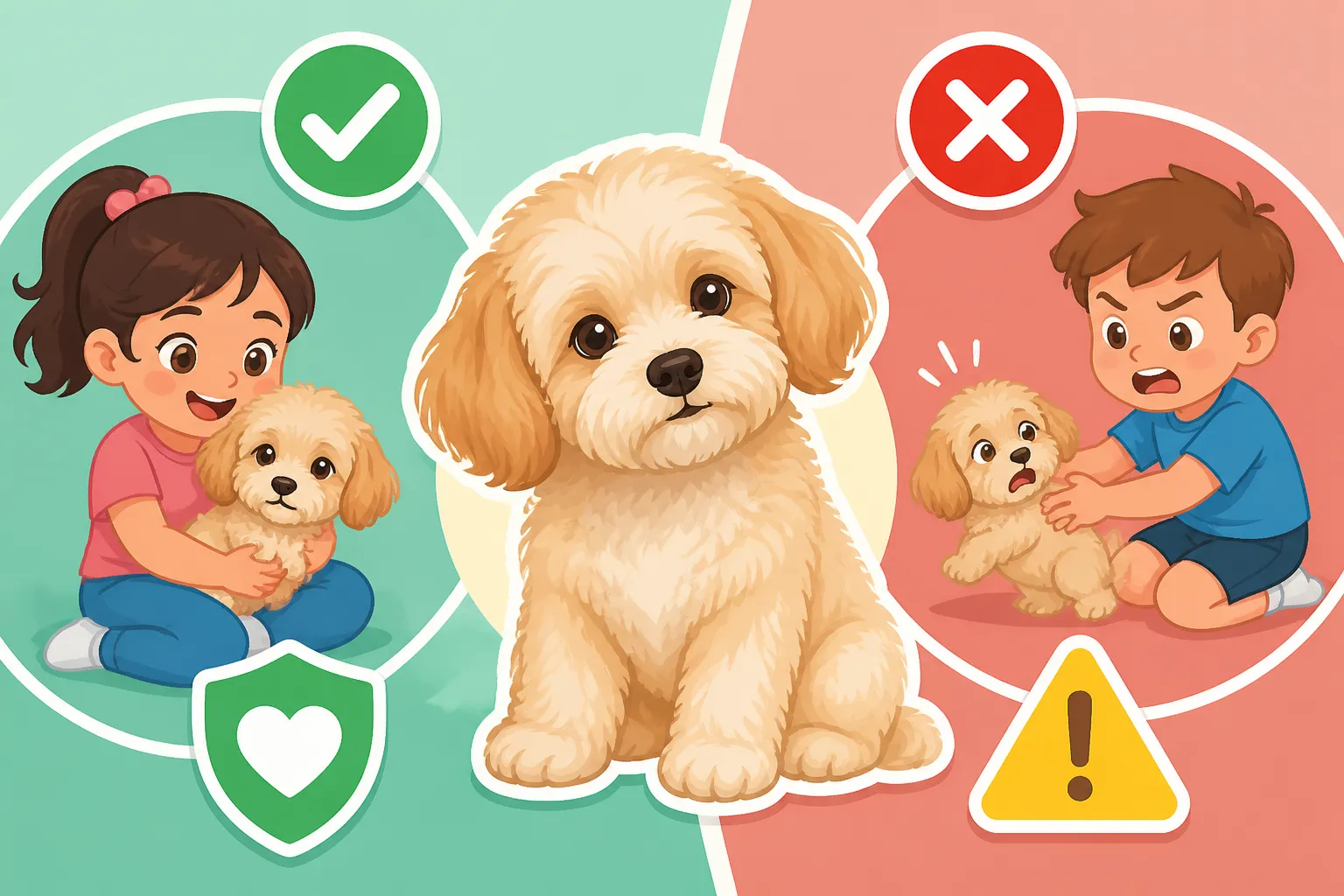
Puppies are especially vulnerable. They may wriggle out of a child’s arms, fall from a chair, or be stepped on while everyone is focused on playtime. A Maltipoo’s size does not make every bump a medical emergency, but it does make prevention important. Keep the puppy on the floor or in a secure adult’s arms, rather than letting a child carry it around.
If your main concern is whether a toddler’s handling could cause an injury, Whether a Child Can Hurt a Maltipoo by Holding It explores that issue in more detail. For a household with a very young child, it is also worth reading Whether a Maltipoo Is Too Fragile for a Toddler before deciding what supervision and boundaries would realistically require.
A small dog can still feel frightened or defensive
Being tiny does not mean a Maltipoo will automatically tolerate grabbing, chasing, or noisy play. A dog that feels trapped may try to move away, hide, growl, or snap if its warnings are missed. Those reactions are not proof that the dog is “bad”; they can be signs that it needs space or that a child’s approach is too much.
Children may also mistake discomfort for play. A dog turning its head away, repeatedly licking its lips, trying to leave, or going still deserves a break. Teach children that the dog is allowed to walk away and that following it into a crate, bed, or quiet corner is not permitted.
No child should be expected to manage a dog’s signals alone. Adults need to stay close enough to intervene before a situation escalates, not just listen from another room. For guidance on the supervision question, see Whether a Maltipoo Should Be Left With Children.
Is a Maltipoo the Right Fit for Your Child’s Age and Temperament
Think about the child’s behavior, not just their age
Age can offer a rough clue, but it does not tell the whole story. One preschooler may reliably sit still and follow simple rules; another may be impulsive, loud, or fascinated by picking animals up. Consider what your child does when excited, frustrated, or tired. Can they stop when asked? Can they leave a sleeping animal alone? Can they accept that the dog may choose not to interact?
If the honest answer is “not yet,” that does not necessarily rule out having a dog. It does mean an adult must manage every interaction and use physical separation when attention is elsewhere. A baby gate or playpen can give the dog a child-free resting area while still letting the household stay connected. A dog’s crate can be a safe retreat too, provided children are taught not to reach inside or disturb the dog there.
Families weighing this decision more broadly may find Whether a Maltipoo Suits a Family With Children helpful. The key question is not whether a Maltipoo is generally good with kids; it is whether the adults in your particular home can reliably prevent rough handling and give the dog a way to opt out.
Match the dog’s individual temperament to your household
Maltipoos are individuals. Some are confident and social; others are easily startled or prefer a quieter home. A puppy’s behavior during a short visit does not guarantee how it will respond to a busy household as it matures. Ask about the dog’s experiences with children, handling, household sounds, and being calmly separated from people. Observe how it recovers after a startle, rather than focusing only on whether it approaches you.
A boisterous, unpredictable dog can be difficult around small children regardless of size. On the other hand, a calm dog still needs protection from a child who has not learned gentle behavior. Avoid choosing a puppy simply because it is the smallest one in a litter or because someone promises it will be especially tolerant. A smaller dog may be more vulnerable, not easier for children to handle.
Noise and constant activity also matter. A Maltipoo that has no quiet place to rest may become stressed, especially in a home with frequent visitors or energetic play. If that sounds like your household, Whether a Maltipoo Copes With a Loud House can help you think through the dog’s need for downtime.
Practical Rules for Safe Child and Maltipoo Interactions
Create clear rules that children can understand
Keep the rules short and consistent. For example: pet gently, let the dog come to you, do not pick it up, and leave it alone when it is eating or sleeping. Young children learn better when an adult demonstrates what “gentle” looks like using a stuffed animal or by guiding a slow hand along the dog’s shoulder while the adult supports the interaction.
Avoid asking a child to hug, kiss, or hold the dog. These gestures can feel restrictive or uncomfortable to a dog, and a small dog may have little ability to move away when a child is leaning over it. Instead, invite a calm interaction: the child can sit on the floor, offer an open hand for the dog to sniff, and pet briefly if the dog approaches and remains relaxed.
A simple household guide can help everyone follow the same expectations:
| Situation | Safer approach | Adult’s role |
|---|---|---|
| The dog is resting | Let it sleep without touching or calling it | Keep children away from its bed or crate |
| The child wants to pet the dog | Have the child sit calmly and pet briefly with guidance | Watch the dog’s body language and end the interaction if it moves away |
| The dog is eating | Give it privacy | Separate the child until the meal is finished |
| The child wants to carry the dog | Do not allow carrying | An adult can lift and support the dog when necessary |
| Play becomes loud or fast | Pause and give the dog a quiet space | Step in before chasing or grabbing begins |
For more detailed handling ideas, read Teaching a Child to Hold a Maltipoo. In many families, the safest rule for young children is simpler: children do not carry the dog at all.
Set up the home so supervision is realistic
Safety works best when it does not depend on everyone remembering a rule every second. Use closed doors, gates, or a playpen to separate the dog when you are cooking, answering the door, or helping another child. Set up a quiet dog-only area where children cannot follow. If the dog has learned to rest there, that space can become a predictable refuge instead of a punishment.
Before buying barriers or other dog equipment, measure the space and check that the setup suits your dog’s size and the way your family uses the room. Chewy is one place to compare pet gates and playpens, but the fit and safe installation matter more than the retailer. For walks, choose a properly fitted harness and supervise any child who is holding the leash; a sudden pull can unbalance a young child or put the dog in an awkward position. Chewy may also be a place to browse harness options, but confirm fit with your dog’s measurements and ask your veterinarian or groomer for help if you are unsure.
Make sure every adult in the home agrees on the boundaries. It is confusing for a child if one person allows chasing or couch cuddles while another insists the dog must be left alone. If an adult cannot actively supervise, separate the child and dog rather than hoping they will manage peacefully on their own. For homes with another pet, consider the extra interactions too; Whether a Maltipoo Is Safe Living With a Large Dog covers a different but related small-dog safety concern.
Signs the Arrangement Is Working and When to Reconsider
Look for calm, voluntary interaction
A good interaction is not one where the dog simply stays still while the child does whatever they like. Look for the dog choosing to approach, remaining loose and relaxed, and being able to leave. The child should be able to follow directions, keep their hands gentle, and accept when the dog walks away.
Notice patterns over time. If the dog repeatedly hides when the child enters, stiffens during handling, or growls when approached, change the setup rather than scolding the warning away. Give the dog more distance, reduce the length of interactions, and involve a veterinarian or qualified behavior professional if the concern persists. Adults should also take any bite or injury seriously and seek appropriate medical and veterinary care.
A Maltipoo does not have to be constantly available to be a family dog. Short, positive interactions followed by quiet time are often more comfortable than long sessions of attention. If the dog seems uneasy in a busy home, Whether a Maltipoo Needs Company Most of the Day may help you distinguish social needs from the need for uninterrupted rest.
Be honest about the amount of adult oversight required
A Maltipoo may fit into a home with children when adults are willing to manage the environment, teach respectful handling, and protect the dog’s downtime. It may be a poor fit if the plan depends on a toddler being careful without close supervision, or if the dog will routinely be left in the middle of noisy, unsupervised play.
There is no single age at which every child becomes ready to share space safely with a small dog. Readiness shows up in repeated behavior: following rules, stopping when asked, and understanding that an animal is not a toy. Even a responsible older child should not be the only person supervising a young child and a dog.
A family that adopts a Maltipoo should plan for safety as part of everyday life, not as a temporary precaution. That means adult-managed handling, protected rest areas, calm introductions, and a willingness to separate the dog and child whenever supervision is distracted. Those habits help the child build a respectful relationship and give the Maltipoo the security to feel at home.
Disclaimer
This article is for general informational purposes only and does not constitute professional advice. Laws, prices and regulations vary by location and change over time. Consult a qualified professional for guidance on your specific situation.