Whether Bigger Dogs Bully a Maltipoo at the Park
It’s a heart-wrenching scenario many Maltipoo owners have probably envisioned: you take your beloved little fluffball to the dog park, hoping for some joyous playtime, only to find them overwhelmed, scared, or even accidentally hurt by much larger, boisterous dogs. This guide is going to walk you through the very real concerns of bringing a small dog like a Maltipoo into an environment dominated by big breeds, how to assess the risks, and practical strategies to ensure your Maltipoo's safety and enjoyment, whether at the park or through alternative socialization methods.
The Real Risks of Size Disparity at the Dog Park
Let's be honest, the dog park can feel like a jungle, especially when you're the parent of a tiny Maltipoo. The sheer difference in size between your ten-pound companion and a seventy-pound Labrador can be terrifying. It's not just about deliberate aggression; often, the biggest dangers come from accidental collisions or misunderstandings in play style. You worry about a happy-go-lucky giant accidentally trampling your little one, or a playful nip that's just too strong for a small jaw. These aren't irrational fears; they're legitimate concerns that require careful consideration.
The "Bully" Isn't Always Malicious
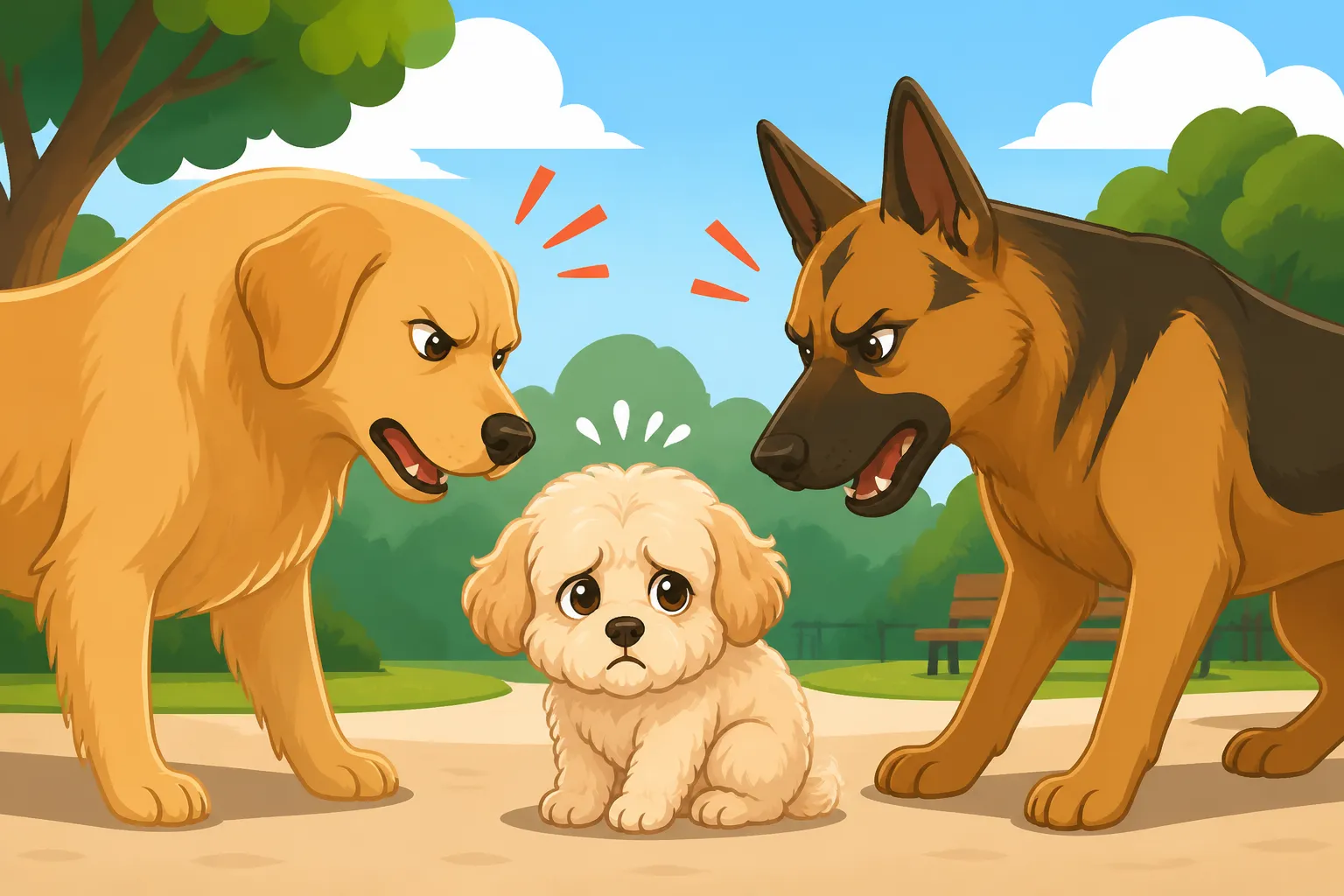
It's easy to label a larger dog that seems to be roughhousing with your Maltipoo as a "bully," but often, their intentions aren't malicious at all. Large dogs are simply built differently, and their play style reflects their size and strength. A playful charge or a gentle body slam from a Golden Retriever or a German Shepherd might be perfectly acceptable play between two equally sized dogs, but for a Maltipoo, it can be devastating. They don't mean to hurt, they just don't understand the fragility of a much smaller playmate. Think of it like a toddler trying to play with a delicate ceramic doll – they don't mean to break it, but their lack of fine motor control and understanding of fragility can lead to damage. Similarly, many large dogs lack the instinct or learned behavior to temper their play for smaller companions.
This often leads to mismatched play. A large dog might chase your Maltipoo, seeing it as a fun game, while your Maltipoo interprets it as being hunted or threatened. The vocalizations can also be misread; a large dog's excited bark might sound aggressive to a small dog, and a Maltipoo's yelp might just egg on a big dog who thinks it's part of the game. It's a communication breakdown rooted in physical differences, and it puts your Maltipoo at a significant disadvantage.
The Sheer Physics of Size Differences
This isn't about blaming larger dogs or their owners; it’s simply acknowledging the laws of physics. A Maltipoo typically weighs between 5 to 15 pounds, with "teacup" varieties being even smaller. A dog weighing 50 pounds or more has a huge advantage in mass, momentum, and sheer physical power. A collision, even an accidental one during a game of chase, could result in serious injury for your Maltipoo. We're talking about anything from sprains and fractures to more severe internal damage. You can read more about the general risks in Whether a Maltipoo Can Be Injured by a Fall.
Consider a scenario: a Rottweiler and a Maltipoo are both running towards a dropped tennis ball. The Rottweiler doesn't see your Maltipoo in its blind spot and accidentally clips them with its shoulder. For the Rottweiler, it's a minor bump. For your Maltipoo, that could mean a broken rib, a knocked-out tooth, or a concussion. Their small bones and delicate frame are simply not equipped to handle the impact from a dog many times their size. This is why vigilance is absolutely non-negotiable at a dog park, especially if there are large dogs present. Even the most well-meaning big dog can pose a significant risk due to pure physics.
How a Maltipoo's Temperament Plays a Role
Maltipoos often inherit a wonderful blend of traits from their Maltese and Poodle parents. The Maltese can bring a bold, confident, sometimes even feisty spirit, while the Poodle contributes intelligence and eagerness to please. However, this mix can also mean a Maltipoo who doesn't fully grasp their own small stature. Some Maltipoos, particularly those leaning more towards the Maltese personality, can be quite fearless, even attempting to initiate play with much larger dogs. This can be adorable, but it's also incredibly risky. A small dog with a big personality might not retreat when a larger dog gets too rough, leading to a dangerous escalation.
Conversely, a Maltipoo with a more timid or sensitive temperament might become easily overwhelmed and stressed in a chaotic dog park environment. This can manifest as hiding, cowering, or even fear-based aggression, which can paradoxically make them a target for curious or pushy larger dogs. Understanding What the Maltese Puts Into a Maltipoo's Character and What the Poodle Puts Into a Maltipoo's Character can give you insights into your specific dog's predispositions. It's crucial to assess your Maltipoo's individual comfort level and personality when deciding if a mixed-size dog park is truly a suitable environment for them. A dog that is constantly stressed or scared isn't enjoying their time, even if they aren't physically hurt.
Recognizing Unsafe Play and Intervention Strategies
Your primary job as a Maltipoo parent at the dog park is to be an eagle-eyed observer and your dog's best advocate. Don't be that owner glued to your phone; your Maltipoo is depending on you to read the room and intervene when necessary. This means understanding dog body language, both your Maltipoo's and the other dogs'.
Signs Play is Turning Sour
Dogs communicate constantly through body language, and it's essential to learn their cues. What starts as innocent play can quickly escalate, especially with a size mismatch. Here are some red flags to watch for:
- Your Maltipoo is constantly trying to escape or hide: If they're repeatedly ducking under benches, trying to get behind your legs, or showing "whale eye" (the whites of their eyes are visible), they're signaling distress.
- The bigger dog is "pinning" or constantly mounting your Maltipoo: Even if done playfully, persistent pinning can be intimidating and potentially physically harmful to a small dog. Mounting is often a display of dominance, not play.
- One dog is doing all the chasing: If your Maltipoo is always the one being chased, without turning the tables or showing reciprocal interest, it's not mutual play. It's a chase, which can quickly become a prey drive scenario for some larger breeds.
- Hard stares, stiff body language, or hackles raised: These are clear signs that a dog is uncomfortable, challenged, or preparing for conflict.
- Excessive growling or snapping that isn't brief and playful: While some growling is normal in play, if it's sustained, deep, or accompanied by bared teeth, it's a warning.
- Changes in vocalization: A high-pitched, distressed yelp from your Maltipoo that isn't a quick "ouch" sound but a sustained cry is a big red flag.
- Ignoring appeasement signals: If your Maltipoo is doing things like lip-licking, turning their head away, or showing a submissive crouch, and the other dog isn't responding by backing off, intervention is needed.
When to Step In (and How)
Knowing when to step in is just as important as knowing how. Don't wait until things escalate into an outright fight. If you see any of the signs above, it’s time to act.
- Be Calm but Decisive: Panicking will only stress your Maltipoo further and potentially escalate the situation.
- Recall Your Dog: If your Maltipoo has a reliable recall, use it immediately. A strong "come" cue can extract them from a dicey situation. Training a solid Teaching a Maltipoo to Come When Called is invaluable for park safety.
- Create a Barrier: If the other dog isn't responding to your verbal cues, use your body to gently, but firmly, block them from your Maltipoo. Don't put your face close to the other dog's face or make sudden, aggressive movements.
- Leash Up: Get your Maltipoo on a leash and remove them from the immediate area. You might need to leave the park entirely if the situation isn't improving or if the other owner isn't responsive.
- Communicate with the Other Owner: Politely explain your concerns about the size difference and play style. Sometimes owners are oblivious or genuinely believe their large dog is "just playing." A simple, "My Maltipoo is very small, and your dog's play style is a bit too rough for them, so we're going to take a break," can work wonders. If they are dismissive or rude, it's time to find a different park or time to visit.
Never grab your Maltipoo directly out of the middle of a conflict, as this could result in a redirected bite from either dog. Distraction, like clapping loudly or making a sudden noise, can sometimes break a dog's focus long enough for you to grab your Maltipoo.
Teaching Your Maltipoo to Navigate Big Dogs
While you can't control other dogs, you can certainly equip your Maltipoo with confidence and crucial skills. Socialization isn't just about throwing dogs together; it's about controlled, positive exposure.
- Desensitize and Counter-Condition: If your Maltipoo is fearful of larger dogs, start with very controlled, brief exposures from a distance. Reward calm behavior with high-value treats. Gradually decrease the distance as your Maltipoo becomes more comfortable. This process should always be positive and never forced.
- Teach a Strong "Leave It" and "Watch Me": These commands are lifesavers. "Leave It" can prevent your Maltipoo from investigating a potentially aggressive dog or resource guarding incident, and "Watch Me" helps you regain their focus instantly.
- Build Confidence: Enroll in obedience classes, even if your Maltipoo knows basic commands. Group classes, like those offered by BAXTER & Bella, can help your Maltipoo learn to focus on you amidst distractions, including other dogs of various sizes. This builds confidence in your dog and strengthens your bond, making them more likely to look to you for guidance in new situations.
- Positive Experiences: Seek out opportunities for controlled, positive interactions with calm, known large dogs. If your friend has a gentle giant, arrange a supervised playdate in a neutral yard where you can closely monitor and intervene if needed. This allows your Maltipoo to learn that big dogs aren't all scary.
Alternatives to the Traditional Dog Park Experience
Let's face it, not all dog parks are created equal, and some Maltipoos are simply not cut out for the free-for-all environment. And that's perfectly okay! Your Maltipoo can still be well-socialized and happy without ever stepping paw in a large, mixed-breed dog park.
Small Dog Only Areas
Many modern dog parks, especially in larger cities or newer developments, are wisely incorporating separate areas for small and large dogs. These designated "small dog" sections are often fenced off, providing a much safer environment where your Maltipoo can run, play, and interact with dogs their own size without the looming threat of accidental injury.
The benefits here are obvious: your Maltipoo can engage in appropriate play without fear. A playful pounce from another Maltipoo, Shih Tzu, or miniature Poodle is far less likely to cause harm than one from a Rottweiler. However, even in small dog parks, vigilance is still key. Not all small dogs have impeccable manners, and play can still get too intense. Always observe the dynamics, look for signs of stress in your Maltipoo, and be ready to intervene. This also brings up the point that not all dogs labeled "small" truly fit the bill. A 20-pound Beagle might be considered "small" by some standards, but they could still easily overwhelm a 5-pound Maltipoo. Know your dog's comfort zone, and don't hesitate to leave if the dynamics feel off.
Supervised Play Dates with Known Dogs
This is, by far, one of the safest and most beneficial ways to socialize your Maltipoo. Instead of the unpredictability of a public park, arrange play dates with dogs you know personally and whose temperaments and play styles you trust.
- Start with one-on-one: Introduce your Maltipoo to a single, calm, well-mannered dog first. This allows for focused interaction without the chaos of multiple dogs.
- Neutral territory: Initially, a neutral yard or fenced area is ideal, rather than one dog's home territory.
- Mix sizes carefully: If you want your Maltipoo to be comfortable around larger dogs, choose a large dog that is known to be gentle and respectful of smaller dogs. Observe their initial interactions closely. Does the larger dog sniff politely and back off, or immediately try to pounce?
- Keep it short and sweet: Positive, brief interactions are more beneficial than long, stressful ones. End the playdate on a good note before either dog gets overstimulated or tired.
- Rotate playmates: Expose your Maltipoo to a variety of trusted canine friends over time to build their social skills broadly.
This controlled environment minimizes stress and maximizes positive learning, fostering confidence in your Maltipoo without putting them at undue risk.
Exploring Other Socialization Avenues
Dog parks and playdates aren't the only ways for your Maltipoo to be a well-adjusted member of canine society. There are plenty of other enriching activities:
- Obedience Classes: As mentioned earlier, group obedience classes are fantastic. Your Maltipoo learns to focus on you amidst the presence of other dogs. They learn manners and impulse control, and simply being in the same room as other dogs in a structured way builds confidence. Online platforms like BAXTER & Bella offer excellent resources for at-home training that can then be applied in real-world settings, helping your Maltipoo gain confidence before stepping into a class.
- Walking in Dog-Friendly Areas: Take your Maltipoo for walks in neighborhoods or on trails where you'll encounter other dogs on leashes. This allows for "parallel walking," where dogs can observe each other without direct interaction, which is a very natural and low-stress form of socialization. Always keep your Maltipoo on a secure harness to protect their delicate trachea. You can learn more about this in Whether a Harness Protects a Maltipoo's Windpipe.
- Pet-Friendly Stores: Many pet supply stores welcome well-behaved, leashed dogs. This offers a different kind of sensory experience and exposure to other dogs and people in a controlled indoor environment.
- Doggy Daycare (Small Dog Specific): If your Maltipoo needs regular socialization and you're away during the day, look for a reputable doggy daycare that offers separate play areas for small dogs. Research thoroughly, ask for tours, and check references to ensure a safe and stimulating environment.
The goal is quality over quantity when it comes to socialization. A few positive, controlled interactions are far more valuable than a dozen overwhelming or scary ones.
Products and Training to Support Your Maltipoo's Safety
Being prepared with the right gear and consistent training can make a huge difference in keeping your Maltipoo safe, whether you venture to the dog park or stick to more controlled environments.
Essential Gear for Park Visits
When you do decide to take your Maltipoo to a mixed-size dog park, or even a small dog park, having the right equipment is non-negotiable. This isn't just about comfort; it's about active safety.
- A Secure Harness: Never, ever use a collar for walks or park visits with a Maltipoo. Their tiny, delicate tracheas are highly susceptible to damage from pulling or even light tugs on a collar. A well-fitting harness distributes pressure across their chest and shoulders, protecting their windpipe. Look for harnesses designed specifically for small breeds, often available on platforms like Amazon, which offer a snug fit without chafing. For more on this, check out What a Maltipoo's Harness, Bed and Carrier Cost.
- A Sturdy Leash: A six-foot leash is ideal for giving your Maltipoo some freedom to explore while still allowing you to maintain control. Avoid retractable leashes, as they can snap back, injure your hand, or fail to provide adequate control in an emergency.
- High-Value Treats: These are your secret weapon for recalls, focus work, and positive reinforcement. Small, soft, smelly treats are perfect for getting your Maltipoo's attention quickly.
- A "Puppy Purse" or Carrier: For very small Maltipoos or situations where you feel your dog needs a break from the ground, a comfortable sling or carrier can be invaluable. This allows you to scoop them up quickly if a situation looks like it's escalating or if they just need a safe space to retreat to. It's also great for carrying them in and out of the park, avoiding potentially dangerous greetings at the gate.
- Water and a Portable Bowl: Hydration is key, especially during active play.
Building Confidence Through Training
Beyond simply protecting your Maltipoo physically, building their confidence through training is one of the best long-term safety measures you can implement. A confident Maltipoo is less likely to react fearfully or aggressively, and more likely to look to you for guidance.
- Reliable Recall: We can't stress this enough. A Maltipoo that comes every single time you call, regardless of distractions, is a safer Maltipoo. Practice in various environments, gradually increasing distractions. Start at home, then in the yard, then a quiet park, then a busier park. Make coming to you the most rewarding thing ever with enthusiastic praise and fantastic treats.
- "Stay" and "Wait": These commands can keep your Maltipoo out of harm's way. A strong "stay" can prevent them from rushing up to an unknown dog or running into a potentially dangerous situation.
- Desensitization to Noise and Movement: Dog parks are loud and unpredictable. Gradually expose your Maltipoo to various noises, movements, and sights in controlled environments. Play recordings of dog park sounds at a low volume and reward calm behavior. This helps them build resilience.
- "Focus" or "Watch Me": Teach your Maltipoo to make eye contact with you on cue. This is an attention-getter that can snap them out of an overstimulated state and redirect their focus to you.
- Professional Guidance: Don't hesitate to seek advice from a certified professional dog trainer if you're struggling with specific behaviors or if your Maltipoo has a history of fear or anxiety. They can provide tailored strategies and help you and your dog navigate social situations more effectively. Services like BAXTER & Bella offer a comprehensive online program that can guide you through all these training steps from the comfort of your home, preparing your Maltipoo for the world outside.
Conclusion
The question of whether bigger dogs bully a Maltipoo at the park isn't always about malicious intent; it's often about a dangerous mismatch in size, play style, and communication. While many large dogs are gentle souls, the physics of their playful interactions can pose serious risks to a tiny Maltipoo. As a responsible owner, your vigilance is your Maltipoo's best protection.
It’s crucial to assess your individual Maltipoo's personality and comfort level, understand the risks, and actively manage their social environment. Whether you choose to carefully navigate mixed-size dog parks, opt for small-dog-only areas, or focus on controlled playdates and structured training, your goal should always be to provide safe, positive, and enriching socialization experiences. Remember, a happy, well-adjusted Maltipoo doesn't necessarily need to conquer the biggest dog park; they just need to feel secure and loved, with plenty of opportunities to express their natural doggy behaviors in a safe way.
Disclaimer
This article is for general informational purposes only and does not constitute professional advice. Laws, prices and regulations vary by location and change over time. Consult a qualified professional for guidance on your specific situation.