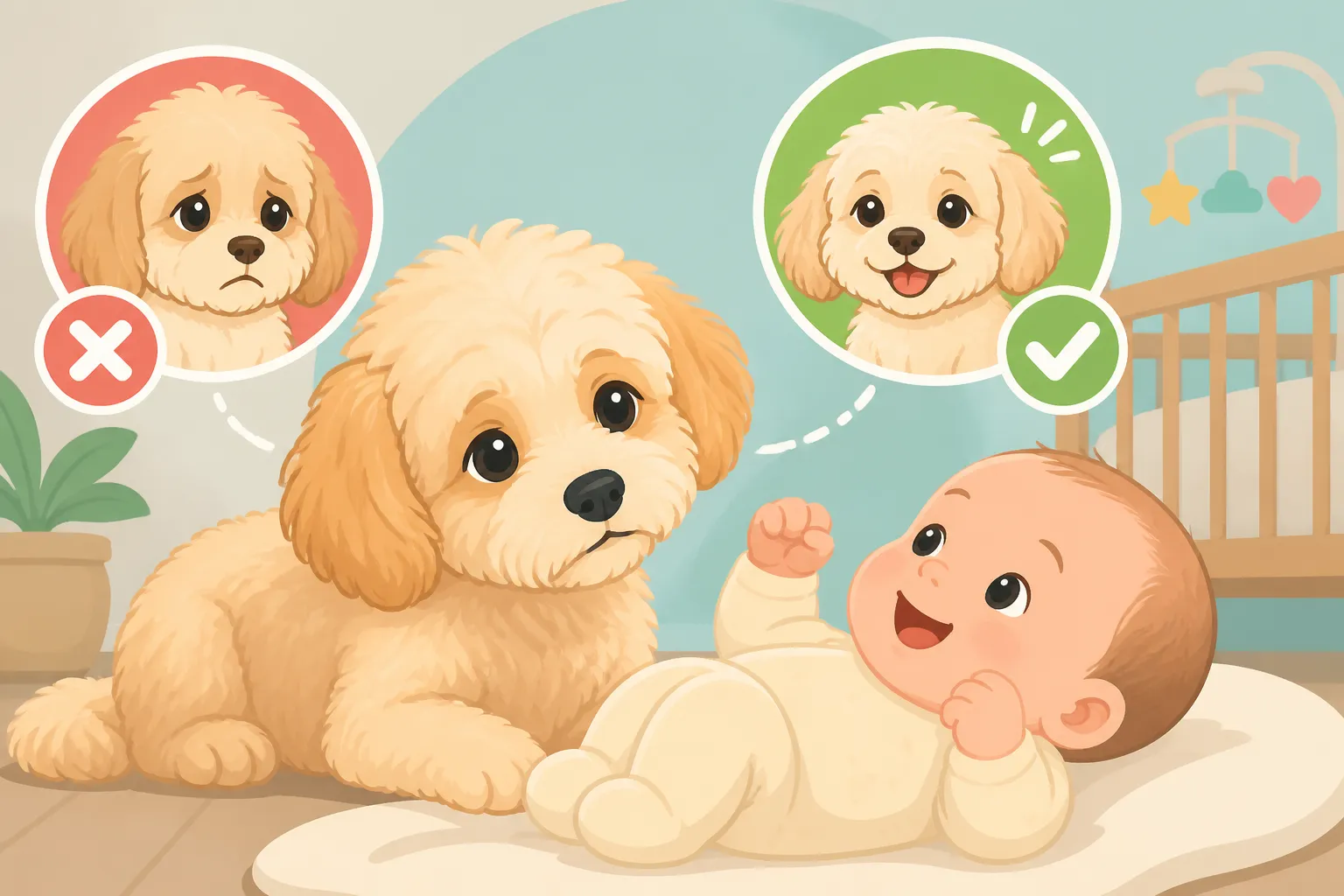
Whether a Maltipoo Copes Around a New Baby
A new baby changes the sounds, smells, schedules, and boundaries of a home, and even a friendly Maltipoo may find that adjustment unsettling. Most can learn to share a household safely with an infant, but success depends on preparation, close supervision, and giving the dog a calm place to retreat. This guide explains how to get ready and what to watch for.
Can a Maltipoo Adjust to Life With a New Baby
A Maltipoo’s temperament matters more than its label
Maltipoos are often affectionate, people-oriented companion dogs, but there is no single Maltipoo temperament. One may snooze through a baby’s cries; another may bark at unfamiliar sounds, cling to a favorite person, or find sudden changes stressful. Age, previous experiences, socialization, health, and the individual dog’s personality all shape how it responds.
Think about how your dog already handles everyday surprises. Does it startle when the doorbell rings? Does it settle when visitors arrive, or become overexcited? Can it relax behind a gate while the family is busy? These patterns offer more useful clues than breed stereotypes. A dog that struggles with noise or guarding its lap may need extra support before the baby comes home.
For a broader look at the range of family situations Maltipoos may suit, see Whether a Maltipoo Suits a Family With Children and A Maltipoo in a House With Children. A baby is different from an older child, though: an infant cannot follow safety rules, so the adults carry the full responsibility for managing interactions.
A baby’s movements and sounds can feel unfamiliar
Babies cry, kick, wave their arms, and move unpredictably. As a baby grows, rolling and crawling can bring them suddenly closer to a dog’s bed, toys, or food bowl. Even a gentle Maltipoo may startle or react if it is startled, in pain, cornered, or repeatedly disturbed while resting.
This is not a reason to assume your dog will be aggressive. It is a reason to avoid leaving the two together without an adult actively supervising. “They’ve always been sweet together” does not replace supervision, especially once the baby becomes more mobile. A dog should always have a way to move away, and a baby should never be placed where the dog has no choice but to tolerate contact.
How to Prepare Your Maltipoo Before the Baby Arrives
Introduce changes gradually
If possible, begin adjusting the household routine before the baby arrives. Set up the crib, stroller, changing area, and any gates early, so they do not all appear at once. Let your Maltipoo investigate new items at its own pace, while preventing access to anything unsafe. Pair calm curiosity with praise or a small treat; there is no need to push the dog toward unfamiliar equipment.
You can also introduce baby-related sounds at a low volume during relaxed moments. Keep the session short and stop if your dog seems worried. Over time, the goal is simply for these sounds to become ordinary background noise—not for your dog to endure loud recordings or be forced to approach them. If the dog walks away, let it.
Practice the routines you expect to use after the birth. For example, teach your dog to settle on a mat while you sit in a chair, or to wait behind a gate while you carry a laundry basket. This gives the dog a familiar job when your attention is elsewhere. Rewarding calm behavior is more helpful than scolding barking or nervousness, which can add stress to an already changing environment.
Build a retreat and rehearse household boundaries
Choose a comfortable spot where your Maltipoo can rest undisturbed, such as a bed in a quiet room or a gated area away from the busiest parts of the home. Make it pleasant before the baby arrives, and let the dog choose to use it. Children and visitors should not reach into this space to pet the dog. A retreat only works if the dog can genuinely rest there without being followed.
Use gates, closed doors, or a playpen to manage access rather than relying on verbal commands alone. A gate can separate the dog from the baby’s sleep area while still allowing the dog to see and hear normal household activity. Check that the setup is stable and that the dog cannot squeeze through, jump over, or become trapped. Small dogs can be surprisingly determined when they want to follow their people.
If you need practical supplies such as a bed, gate, or enrichment toy, Chewy is one place owners may compare available options; choose items that suit your layout and your dog’s size rather than buying a setup that does not fit the home. A food puzzle or safe chew can help occupy the dog during a feeding, but it should be offered in a separate, protected space where the baby cannot reach it.
Introducing a Maltipoo to a Newborn Safely
Keep the first meeting calm and controlled
There is no need to stage a dramatic introduction. After the baby comes home, let the dog approach only if it is calm and an adult can manage the situation. Keep the dog on a leash or behind a barrier if that makes handling easier, and have another adult hold the baby securely. Allow a brief look or sniff from a comfortable distance, then reward the dog for calm behavior and give it the option to move away.
Avoid lifting the baby toward the dog’s face or allowing licking, pawing, or close contact around the baby’s head. These interactions are difficult to control and are not necessary for the dog to become accustomed to the baby. If your Maltipoo seems tense, keeps turning away, pants when it is not hot, stiffens, hides, or repeatedly tries to leave, end the interaction and give it space.
| Situation | Safer approach | What to avoid |
|---|---|---|
| First introduction | Keep it brief, calm, and supervised | Forcing the dog to approach |
| Baby is feeding | Give the dog a settled spot or barrier nearby | Letting the dog crowd the baby or feeding space |
| Dog is resting | Let it sleep undisturbed in its retreat | Encouraging the baby to touch or reach toward it |
| Baby is on the floor | Keep the dog at a manageable distance with an adult present | Assuming the dog will move away in time |
| Visitors arrive | Use a gate or quiet room if the dog is overwhelmed | Asking the dog to tolerate repeated greetings |
A calm first meeting is only a beginning. Keep interactions short and positive, especially during the early weeks when the household is tired and routines are unpredictable. If you have another adult at home, agree in advance who will handle the dog during baby care. Planning this when everyone is rested is easier than making decisions mid-crying spell.
Make supervision active, not casual
Active supervision means an adult is close enough, awake, and paying attention to intervene immediately. Watching from across the room while scrolling or cooking is not reliable supervision. If you need to leave, even briefly, separate the dog and baby with a secure barrier or closed door.
As the baby grows, revisit the setup often. A newborn in a bassinet cannot reach the dog, but a crawling baby may move quickly toward the dog’s water bowl, bed, or toys. Keep dog food, chews, and favorite possessions out of the baby’s reach. At the same time, prevent the dog from accessing the baby’s toys, so there is less chance of guarding, chewing, or confusion over what belongs to whom.
For practical guidance about children and small dogs, read Teaching a Child to Hold a Maltipoo and Whether a Maltipoo Is Too Fragile for a Toddler. Those topics become especially relevant as an infant grows into a toddler. Little children should not carry a Maltipoo or be left alone with one, even when the dog is familiar and affectionate.
Reading Stress and Getting Extra Help
Notice early signs that your dog needs space
Dogs often communicate discomfort before they growl or snap. A Maltipoo may turn its head away, lick its lips, yawn when it is not tired, freeze, flatten its ears, tuck its tail, or try to leave. These signs do not prove that a bite is imminent, but they are a clear invitation to reduce pressure and create distance.
Do not punish growling. A growl is useful information that the dog is uncomfortable; punishing it can suppress the warning without changing the underlying feeling. Instead, calmly separate the dog and baby, then consider what made the dog uneasy. Was the dog cornered? Was a nap interrupted? Was someone reaching over its head? Preventing a repeat is safer than expecting the dog to “get over it.”
Some stress shows up as changes in everyday behavior: hiding, barking more, refusing food, pacing, or becoming unusually clingy. If a change is sudden or persistent, speak with your veterinarian. Pain or illness can make a dog less tolerant, and it is worth ruling out a health issue rather than assuming every behavior change is caused by the baby.
Ask for support before a problem escalates
If your Maltipoo has a history of snapping, guarding, severe fear, or difficulty settling around noise, ask your veterinarian or a qualified, reward-based behavior professional for guidance before the baby arrives. A professional can help you plan around the dog’s specific triggers and the layout of your home. If the dog has already lunged, bitten, or repeatedly tried to reach the baby, maintain physical separation and seek professional advice promptly.
A household with a newborn is tiring, so make the safe choice the easy choice. Keep a gate in place, set up the dog’s retreat before you need it, and prepare a few short activities that do not require both hands. Chewy may be useful for comparing basic supplies such as puzzle feeders or washable bedding, but the key is choosing safe items and using them in a separate area—not expecting a toy to replace supervision.
If you are still preparing for the dog’s place in the family, The First Days With a Maltipoo Puppy offers related guidance on helping a Maltipoo settle into a home. For toddler-age handling and supervision questions, Whether a Toddler Is Safe to Leave With a Maltipoo is another useful topic to explore. The same principle runs through every stage: protect the dog’s space, protect the child, and make interactions gradual and adult-led.
Disclaimer
This article is for general informational purposes only and does not constitute professional advice. Laws, prices and regulations vary by location and change over time. Consult a qualified professional for guidance on your specific situation.