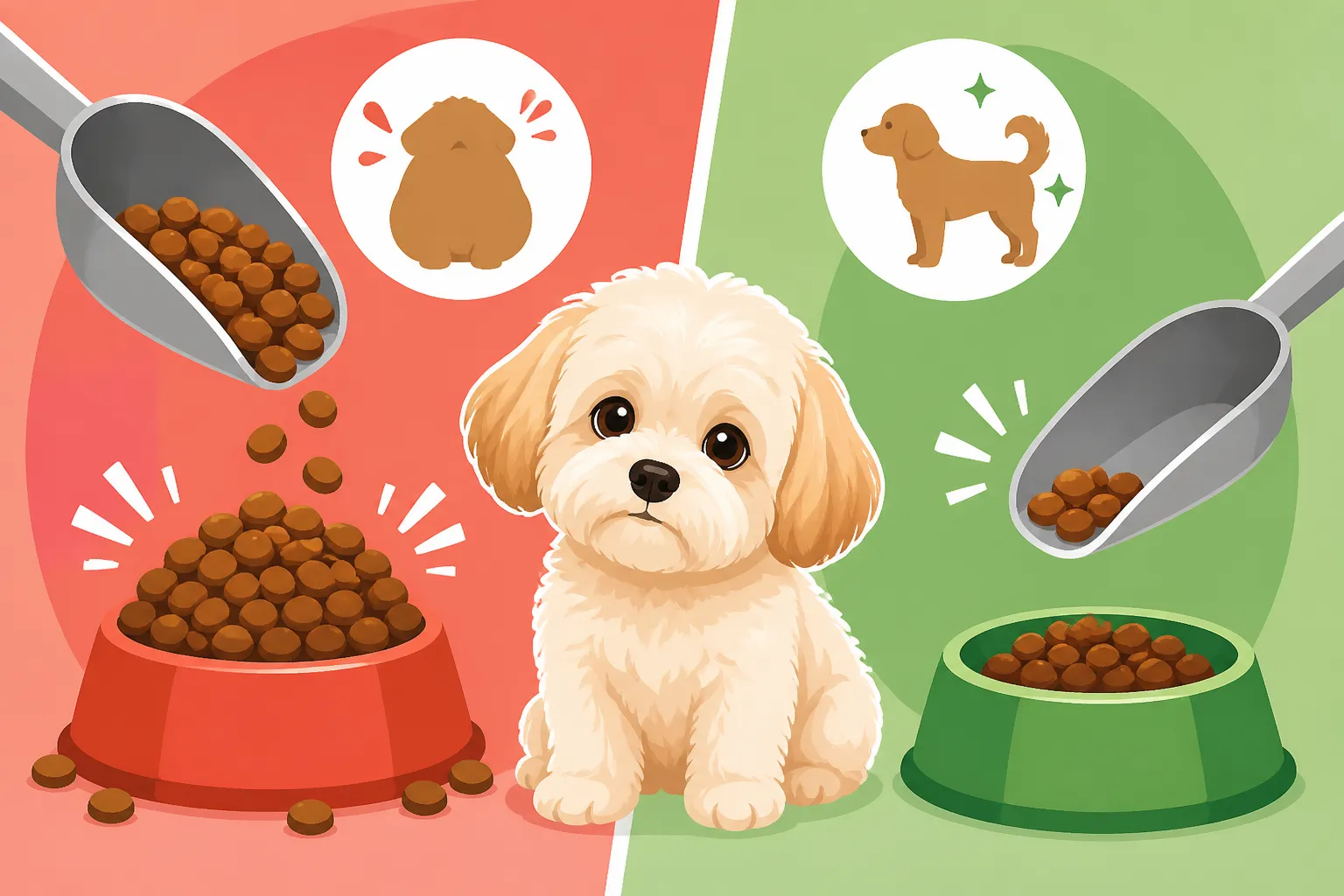
Why a Standard Scoop Overfeeds a Maltipoo
It’s a common, heartbreaking scenario: you love your Maltipoo more than anything, and you want to ensure they're well-fed and happy. You grab that "standard" measuring scoop that came with your dog food, fill it up, and serve a meal, thinking you’re doing everything right. What many owners don't realize is that this seemingly innocent act can lead to overfeeding, significant weight gain, and a cascade of health problems for our tiny companions. This guide will meticulously break down why standard scoops are inadequate for Maltipoos and provide you with precise, actionable strategies to accurately nourish your beloved dog, ensuring they maintain a healthy weight and vibrant life.
The Hidden Danger of Standard Measuring Scoops
When you pick up a bag of dog food, you often find feeding guidelines based on your dog's weight, and perhaps a plastic scoop tucked inside. It all seems so convenient, so straightforward. But for a Maltipoo, these "standard" tools and guidelines can be incredibly misleading, leading to a subtle but persistent overfeeding that can silently undermine their health over time.
Why "Standard" Doesn't Apply to Small Breeds
Imagine trying to measure out spices for a delicate soufflé using a shovel. It sounds absurd, right? Yet, this is precisely the scale of inaccuracy we're dealing with when we apply a "standard" dog food scoop to a Maltipoo. These scoops are typically designed for medium to large breed dogs, often calibrated for portion sizes that are orders of magnitude larger than what a tiny Maltipoo needs. A scoop that looks 'full' for a Labrador might contain enough calories to feed a Maltipoo for an entire day, or even more. The sheer volume difference is staggering. What looks like a small amount of kibble in a standard cup can be a massive calorie bomb for a dog weighing only a few pounds. Our eyes are simply not equipped to discern the subtle, critical differences in volume that translate into significant caloric excess for such a small creature. This visual deception is one of the primary reasons Maltipoo owners unknowingly overfeed, even with the best intentions.
The Caloric Density Deception
Beyond the sheer volume, there's another crucial factor at play: caloric density. Not all dog foods are created equal, even within the same brand. Some premium small-breed kibbles are incredibly nutrient-dense and calorie-rich, formulated to provide ample energy in tiny portions. Other foods might be less dense but still, deliver more calories per cup than your Maltipoo actually needs. The manufacturer's feeding guidelines, while offering a starting point, are often broad averages. They can't account for the specific caloric needs of every individual dog, especially those at the lower end of the weight spectrum like a Maltipoo. The plastic scoop in the bag makes no distinction between a high-calorie performance kibble and a lower-calorie maintenance food. It simply measures volume. Without understanding the caloric content per gram of your specific chosen food, and without an accurate way to measure that food, you're essentially guessing. This guessing game, unfortunately, almost always errs on the side of giving too much, because a slightly underfilled scoop feels like you're depriving your precious pup.
Understanding Your Maltipoo's Unique Nutritional Needs
Maltipoos aren't just smaller versions of larger dogs; their metabolism and energy requirements are distinctly different. What works for a Golden Retriever simply won't work for your delicate Maltipoo, and understanding these nuances is key to their long-term health.
Tiny Bodies, Tiny Calories: The Maltipoo Metabolism
It might seem counterintuitive, but smaller dogs often have a faster metabolism than larger dogs. They burn through energy more quickly, which is why a Maltipoo puppy, for instance, cannot skip a meal without risking serious issues like Hypoglycemia and the Teacup Maltipoo Puppy. However, while their metabolic rate is high, their overall caloric needs are dramatically lower due to their diminutive size. A typical adult Maltipoo weighing around 6 pounds might only require a fraction of the calories a medium-sized dog consumes in a day. We're talking about differences of hundreds of calories, which for a tiny dog, is a monumental amount.
Their small stomach size means they also feel full quickly, but that doesn't necessarily mean they've consumed the right amount of nutrients or calories. It's not about how much they can eat, but how much they should eat to maintain their ideal body condition. Every extra fifty calories in a Maltipoo's diet can quickly tip them into an unhealthy weight category, impacting everything from their joints to their organs. It's a delicate balance that requires precision, not approximation. This is why paying close attention to How Many Calories a Six Pound Maltipoo Needs is so important.
The Impact of Activity Levels on Caloric Intake
Just like humans, a Maltipoo's activity level plays a huge role in determining their caloric needs. A Maltipoo who enjoys several brisk walks a day, plays fetch regularly, and is constantly zipping around the house will naturally burn more calories than a more sedentary pup who prefers to nap on the sofa most of the day. Yet, many owners feed the same amount regardless of their dog's daily expenditure.
Consider a hypothetical Maltipoo named Luna who loves her daily strolls and playtime at the park, burning off more energy. Her caloric needs will be higher than a Maltipoo named Max, who is perfectly content with a short walk and spends most of his day cuddling. If both are fed the same amount using a standard scoop, Max will inevitably gain weight, while Luna might be perfectly maintained. This highlights the importance of individual assessment. You need to observe your Maltipoo's energy levels, playtime habits, and overall activity throughout the day to fine-tune their food intake. A small adjustment – even just a few grams of kibble – can make a substantial difference over weeks and months for such a small dog.
The Real-World Consequences of Overfeeding
It’s not just about aesthetics; overfeeding a Maltipoo, even by a little, has significant and often painful health repercussions. What seems like a minor indulgence can drastically shorten their lifespan and diminish their quality of life.
Weight Gain and Its Health Ramifications
An overweight Maltipoo is not a "chubby" or "fluffy" Maltipoo; they are a dog at serious risk. The extra pounds put undue strain on their tiny joints, accelerating conditions like Slipping Kneecaps in a Maltipoo. This common breed ailment can quickly worsen with added weight, leading to pain, mobility issues, and potentially costly surgeries. Beyond joint problems, obesity in Maltipoos can contribute to a host of other severe health issues:
- Heart Disease: The cardiovascular system works harder to support a larger body mass, increasing the risk of heart conditions.
- Diabetes: Just like in humans, excess weight can lead to insulin resistance and diabetes, requiring lifelong management.
- Respiratory Issues: Extra fat around the chest and neck can make breathing more difficult, especially for a breed already prone to Collapsing Trachea in a Maltipoo's Neck.
- Reduced Stamina: An overweight Maltipoo will have less energy, making walks and playtime uncomfortable, turning a naturally energetic dog into a lethargic one.
- Heat Intolerance: Carrying extra insulation makes them more susceptible to overheating, a particular concern for small dogs who struggle to regulate their temperature.
- Shorter Lifespan: Ultimately, all these compounded health problems reduce their overall lifespan, cutting short the precious time you have with your furry family member. This flies in the face of what we hope for with The Twelve to Fifteen Years a Maltipoo Lives.
The reality is grim: every extra pound on a 6-pound Maltipoo is the equivalent of a 200-pound person gaining 30-40 pounds. It's a significant burden on their small frame and delicate systems.
Exacerbating Breed-Specific Health Concerns
Maltipoos, being a crossbreed of Maltese and Poodle, inherit a genetic predisposition to certain health conditions from both sides. While responsible breeding aims to minimize these, overfeeding and subsequent weight gain can significantly worsen existing or latent issues. For instance:
- Dental Disease: While The Forty Two Teeth Crowding a Maltipoo's Jaw is a common problem regardless of weight, an overweight Maltipoo might be less eager for daily teeth brushing, leading to faster plaque and tartar buildup. Furthermore, obesity can be an inflammatory state that indirectly impacts overall health, including dental health. Maintaining a healthy weight is part of the holistic approach to preventing serious conditions like Whether Dental Disease Shortens a Maltipoo's Life.
- Pancreatitis: This painful inflammation of the pancreas can be triggered or exacerbated by a high-fat diet, which often goes hand-in-hand with overfeeding.
- Liver Issues: While a severe condition like The Liver Shunt a Maltipoo Can Inherit From the Maltese is genetic, overall metabolic health is vital for liver function. Excess fat accumulation in the liver, known as hepatic lipidosis, can be a concern in overweight dogs.
- Allergies: While not directly caused by weight, an overweight Maltipoo might experience more severe symptoms if they have allergies, as inflammation from excess fat can heighten the body's overall inflammatory response, potentially making their itching and discomfort worse.
The bottom line is that keeping your Maltipoo at their ideal weight is one of the most proactive and impactful things you can do to safeguard their health, reduce their veterinary bills, and ensure they live a long, comfortable life.
Precision Feeding: The Only Way to Go
If you’ve been relying on measuring scoops, it’s time for a change. For a Maltipoo, precision isn’t just a recommendation; it’s a necessity for their health. The key lies in understanding the true weight of their food and calculating their specific needs.
The Critical Role of a Kitchen Scale
Forget the measuring cups and scoops – they are simply not accurate enough for a dog as small as a Maltipoo. The only reliable way to measure your Maltipoo's food is with a digital kitchen scale. Think about it: a "cup" of kibble can vary wildly in actual weight depending on how tightly packed it is, the shape of the kibble, and even the size of the individual pieces. These seemingly minor variations can add up to significant caloric differences for a small dog. For example, a measuring cup might say 1/4 cup, but depending on the kibble, this could be anywhere from 25 to 35 grams – a 10-gram difference that represents a substantial portion of a Maltipoo's daily intake. This is why Whether Measuring Cups Are Useless for a Maltipoo is a discussion worth having.
A digital kitchen scale allows you to measure food in grams or ounces, which is far more precise. Most quality dog foods will list the caloric content per cup and per gram or kilogram on their packaging. This information, combined with a scale, empowers you to feed your Maltipoo the exact amount of calories they need. It might feel like a bit of extra effort initially, but it quickly becomes a habit, and the peace of mind knowing you're providing optimal nutrition is invaluable. You can find reliable and affordable kitchen scales on platforms like Amazon, making this essential tool easily accessible.
Calculating Your Maltipoo's Ideal Daily Intake
Calculating your Maltipoo’s ideal daily caloric intake involves a few steps, but once you have the numbers, it becomes much easier.
Step 1: Determine Ideal Weight.
First, you need to know your Maltipoo’s ideal adult weight. This isn't necessarily their current weight, especially if they are already overweight. Consult with your veterinarian to establish a healthy target weight for your specific dog. This might be anywhere from 4 to 10 pounds for an adult Maltipoo, but your vet can provide the most accurate assessment.
Step 2: Find the Resting Energy Requirement (RER).
The RER is the amount of calories your dog needs at rest. A common formula is: RER = 70 * (body weight in kg)^0.75.
- To convert pounds to kilograms:
pounds / 2.2 = kg. - So, for a 6-pound Maltipoo:
6 lbs / 2.2 = 2.73 kg. - Then
2.73^0.75 = 2.18. RER = 70 * 2.18 = 152.6 calories.
Step 3: Apply the Daily Energy Requirement (DER) Multiplier.
The RER is then multiplied by a factor based on your dog's age, activity level, and whether they are spayed/neutered.
- Puppies (up to 4 months): 3.0
- Puppies (4 months to 1 year): 2.0
- Intact Adult: 1.8
- Neutered/Spayed Adult: 1.6
- Weight Loss: 1.0 – 1.2
- Weight Gain (underweight): 1.8 – 2.0
Let's use our 6-pound (2.73 kg) spayed adult Maltipoo example:DER = RER * 1.6DER = 152.6 * 1.6 = 244.16 calories per day.
Step 4: Convert Calories to Food Weight.
Now, check your dog food bag for the caloric content. Let's say your kibble has 350 calories per cup, and a cup weighs 100 grams.
- Calories per gram =
350 calories / 100 grams = 3.5 calories/gram. - Daily food amount =
244.16 calories / 3.5 calories/gram = 69.76 grams.
So, your 6-pound Maltipoo would need approximately 70 grams of this specific kibble per day.
This precise calculation takes the guesswork out of feeding and ensures your Maltipoo gets exactly what they need. It's a critical step to prevent issues like being [Overweight].
Practical Tips for Accurate Meal Preparation
Now that you understand the "why" behind precision feeding, let's dive into the "how." Making accurate meal preparation a daily habit is simpler than you might think and will pay dividends in your Maltipoo's health.
Weighing vs. Measuring: A Hands-On Guide
The switch from scoop to scale can feel a little daunting at first, but it quickly becomes second nature. Here’s a step-by-step guide to accurate feeding:
- Invest in a Digital Kitchen Scale: You don't need an expensive, high-tech model. A basic digital kitchen scale that measures in grams and ounces is perfectly sufficient. Many great options are available on online retailers like Amazon.
- Read Your Food Label: Locate the "Guaranteed Analysis" and "Feeding Guidelines" sections on your dog food bag. Find the calorie content per cup, and ideally, the weight of one cup in grams or ounces. If it only gives calories per cup, you'll need to weigh a full cup of your kibble once to determine its average weight in grams.
- Calculate Daily Portion in Grams: Using the DER calculation from the previous section, you'll know your Maltipoo's total daily caloric need. Divide this by the calories per gram of your specific kibble to get the total daily grams of food.
- Example: If your Maltipoo needs 250 calories/day, and your food has 3.5 calories/gram, you'd feed
250 / 3.5 = ~71.4 gramsper day.
- Example: If your Maltipoo needs 250 calories/day, and your food has 3.5 calories/gram, you'd feed
- Divide into Meals: Most adult Maltipoos do best with two meals a day, but puppies might need three or even four small meals. Divide the total daily gram amount by the number of meals.
- Example: For 71.4 grams/day across two meals, each meal would be
71.4 / 2 = 35.7 grams.
- Example: For 71.4 grams/day across two meals, each meal would be
- Weigh Each Meal: Place your Maltipoo's bowl on the digital kitchen scale, turn it on, and hit the "tare" button to zero it out. Carefully pour the kibble into the bowl until the display shows the exact gram amount for that meal.
This method completely eliminates the guesswork. You'll be feeding your Maltipoo the right amount every single time. It might seem like a small detail, but for a tiny dog, these precise measurements are incredibly impactful. Using a precise method like this is far more effective than trying to eyeball it, confirming Whether Measuring Cups Are Useless for a Maltipoo.
Choosing the Right Food and Monitoring Progress
Beyond the amount of food, the type of food also plays a significant role in your Maltipoo's health and weight management.
- Small Breed Specific Formulas: Many brands, including those found on Chewy, offer kibble specifically designed for small breeds. These often have smaller kibble pieces that are easier for tiny mouths to chew and may be formulated with a balanced nutrient profile suited for their faster metabolisms. Check out Whether a Maltipoo Needs Small Breed Kibble for more details on this topic.
- Fresh Food Options: For some owners, fresh, gently cooked food options like Ollie can be an excellent choice. These often come with pre-portioned meals based on your dog's specific weight and activity level, taking much of the guesswork out of the caloric calculation. Just ensure you’re still cross-referencing their recommendations with your Maltipoo's specific needs and your vet's advice.
- Monitor Body Condition Score (BCS): Even with precise weighing, it's vital to regularly assess your Maltipoo's body condition. The BCS is a visual and tactile assessment that helps you determine if your dog is at an ideal weight.
- Ideal: You should be able to easily feel your Maltipoo's ribs with minimal fat covering, see a distinct waist tuck when viewed from above, and a slight abdominal tuck from the side.
- Overweight: Ribs are difficult to feel, no discernible waist, and a rounded abdomen.
- Underweight: Ribs are very prominent, obvious waist, and severe abdominal tuck.
- Your vet can teach you how to accurately score your dog. Regularly check their condition – ideally weekly – and adjust their food intake by a small percentage (5-10%) if they are gaining or losing weight unintentionally. This proactive monitoring is essential for effective Getting a Pound Off an Overweight Maltipoo.
Remember that consistency is key. Stick to the same feeding schedule daily, and make adjustments only gradually and after careful observation. You'll soon see the benefits in your Maltipoo's energy levels, coat condition, and overall vitality.
Navigating Treats and Supplements with Care
Treats are an important part of bonding and training, and supplements can offer beneficial support. However, for a small dog like a Maltipoo, these seemingly minor additions can quickly throw off their carefully calculated daily caloric intake. It's crucial to account for every calorie.
The Sneaky Calories in "Just One Treat"
We all love to spoil our Maltipoos with treats. They give those adorable puppy-dog eyes, and it's so hard to resist! But "just one treat" can be a significant caloric contribution to a tiny dog's diet. A single medium-sized dog biscuit, for example, might contain 20-30 calories. For a 6-pound Maltipoo who only needs around 250 calories a day, that single treat represents 8-12% of their entire daily intake! Give them a few throughout the day for good behavior, and you've easily added an extra half-meal without realizing it.
Here's how to manage treats intelligently:
- Account for All Calories: The golden rule for a Maltipoo is that every calorie counts. If you give treats, those calories must be subtracted from their main meal portions for the day. You'll need to know the calorie count of each treat you offer. Many brands provide this information on their packaging.
- Choose Low-Calorie Options: Look for treats specifically marketed as low-calorie or for small dogs. Small pieces of cooked lean chicken, green beans, or carrots can also be excellent, healthy, and low-calorie alternatives.
- Break Treats into Smaller Pieces: Even a small treat can be broken into multiple tiny pieces. Your Maltipoo will often be just as happy with a crumb as with a whole piece, especially if you're using them for training purposes. This allows you to extend the treat experience without overdoing the calories.
- Use Kibble as Treats: A fantastic strategy is to set aside a portion of your Maltipoo's daily kibble allowance and use that as treats for training or rewards throughout the day. This ensures you're not adding any extra calories beyond their calculated daily needs.
Being mindful of treats is a small habit change that yields huge rewards for preventing weight gain in your Maltipoo. This careful attention extends to overall care, forming part of The Daily Routine a Maltipoo Needs.
Balancing Supplements with Daily Caloric Needs
Supplements are often given with the best intentions, whether it's for joint health, skin and coat, or overall vitality. However, many supplements, especially chews or palatable liquids, contain hidden calories, sugars, and fats. For a Maltipoo, these can add up quickly and contribute to unintentional weight gain.
Consider a hypothetical scenario: You're giving your Maltipoo a joint supplement, hoping to prevent issues like The Age a Maltipoo's Kneecap First Slips. If each chew contains 10 calories, and you're giving one or two daily, you could be adding 20 calories or more to their diet. That's almost 10% of their total daily intake for a 6-pound Maltipoo. Over weeks and months, these small additions can lead to noticeable weight creep.
Here’s how to approach supplements thoughtfully:
- Check Calorie Content: Always read the label on any supplement. If it’s a chew or a soft treat-like supplement, it likely has calories. Account for these in your Maltipoo’s daily caloric budget, subtracting them from their main meal.
- Opt for Non-Caloric Forms: If possible, choose supplements in powder form that can be mixed into food, or plain tablets if your dog takes them easily, as these typically have negligible calories.
- Consult Your Veterinarian: Before introducing any new supplement, always discuss it with your vet. They can advise whether the supplement is truly necessary, recommend specific brands or formulations, and help you understand how to integrate it into your Maltipoo's diet without compromising their weight. Your vet can also help you determine the best daily routine and discuss issues like The Yearly Checks a Maltipoo Should Get.
- Evaluate Necessity: Sometimes, a well-balanced, high-quality dog food already provides all the necessary nutrients, making many supplements redundant. Your vet can help you determine true nutritional gaps.
The goal is to provide beneficial support without inadvertently contributing to weight gain. By being diligent about every calorie your Maltipoo consumes, whether from meals, treats, or supplements, you're setting them up for a lifetime of optimal health and happiness.
Summary of Feeding Methods
To help clarify the differences and advantages of each feeding method, here's a quick comparison:
| Feature | Standard Measuring Scoop | Measuring Cup (Generic) | Digital Kitchen Scale (Grams/Ounces) |
|---|---|---|---|
| Accuracy | Low (highly variable) | Moderate (can be inconsistent) | High (precise to the gram) |
| Ease of Use | Very easy (quick and convenient) | Easy | Moderate (requires initial setup/calc) |
| Calorie Control | Poor (easy to overfeed unknowingly) | Limited | Excellent (exact calorie matching) |
| Consistency | Low | Moderate | High |
| Cost of Equipment | Often free (comes with food) | Low (often already owned) | Low to Moderate (one-time purchase) |
| Recommended for Maltipoo | No, leads to significant error risks | Not ideal for small breed precision | Yes, essential for optimal health |
| Benefit | Convenience (but at a cost) | Better than nothing | Prevents obesity, improves health |
This table clearly illustrates why transitioning to a digital kitchen scale is the superior method for feeding your Maltipoo.
Disclaimer
This article is for general informational purposes only and does not constitute professional advice. Laws, prices and regulations vary by location and change over time. Consult a qualified professional for guidance on your specific situation.