Whether a Maltipoo From Two Maltipoos Is Steadier
It's completely understandable to want a Maltipoo whose personality is as predictable and steady as possible. When you’re bringing a new furry family member into your home, especially a small dog that will be a constant companion, you naturally hope for a certain temperament, a dog that fits seamlessly into your life. Many prospective Maltipoo owners have heard the terms F1, F1b, or F2 and wonder if an F2 Maltipoo – meaning a puppy born from two Maltipoo parents – is somehow "steadier" or more consistent in its temperament. This guide is here to shed light on exactly what these generations mean for personality and what truly influences a Maltipoo's disposition.
Understanding Maltipoo Generations and Their Temperament Roots
When you delve into the world of designer breeds like the Maltipoo, you quickly encounter terms like F1, F1b, and F2. These labels refer to the generation of the crossbreed, and they give us clues about the genetic makeup of the puppy. However, when it comes to predicting temperament, it’s not as straightforward as many people hope. The genetic blend is more of a complex recipe than a simple formula, and it's less about the "F-number" and more about the individual genetic contributions of the parent breeds.
The Genetic Lottery of the F1 Maltipoo
An F1 Maltipoo is the very first cross, a direct offspring of a purebred Maltese and a purebred Poodle. Think of it like a true genetic coin flip. Each puppy in an F1 litter receives a completely random assortment of genes from both parents. This means that within the same litter, you can see a wide spectrum of traits. One F1 puppy might lean heavily towards the Maltese side, being more laid-back, sweet-natured, and perhaps a touch stubborn, while a littermate might inherit more of the Poodle's traits – intelligence, high energy, and a strong desire to please. This variability is what makes F1 Maltipoos so exciting and, for some, a little unpredictable. Their charm often lies in this unique, individual blend, but it also means that you can't guarantee a specific set of characteristics. This is what we often refer to as The Coin Flip Inside Every Maltipoo Puppy.
When we talk about What the Maltese Puts Into a Maltipoo's Character, we're often thinking of their gentle, affectionate nature, their love for cuddling, and their tendency to be excellent lap dogs. They're devoted and can sometimes be a bit headstrong. On the flip side, What the Poodle Puts Into a Maltipoo's Character brings a high level of intelligence, trainability, and often a playful, energetic spark. Poodles are known for their eagerness to learn and their active minds, which can mean a more biddable and responsive companion. The F1 generation is where these two distinct personalities first meet and mix in fascinating, often surprising ways.
The F1b's Lean Towards Predictability (in some traits)
An F1b Maltipoo is a backcross. This means one F1 Maltipoo (Maltese x Poodle) is bred back to one of the original purebred parents, typically a Poodle, but sometimes a Maltese. So, you might have an F1 Maltipoo bred with a Poodle, resulting in a puppy that is roughly 75% Poodle and 25% Maltese. This generation is often sought after by people looking for a specific coat type, particularly those hoping for a curlier, more Poodle-like coat to minimize shedding, which can offer more predictability in that physical trait.
However, when it comes to temperament, the picture isn't always quite so clear. While a higher percentage of Poodle genes might suggest a more Poodle-like intelligence and eagerness to please, it's not a guarantee. Genetics are still complex, and just because a puppy has more of one breed's genes doesn't mean those genes will always express themselves in a dominant way. You're still dealing with a mixed genetic bag, just one that's been tilted more in one direction. Some F1b puppies can indeed seem more "Poodle-biddable," but others might still surprise you with a strong independent streak or the gentle stubbornness that can come from the Maltese side, such as Whether a Maltipoo Inherits the Maltese Stubbornness.
What an F2 Maltipoo Really Means Genetically
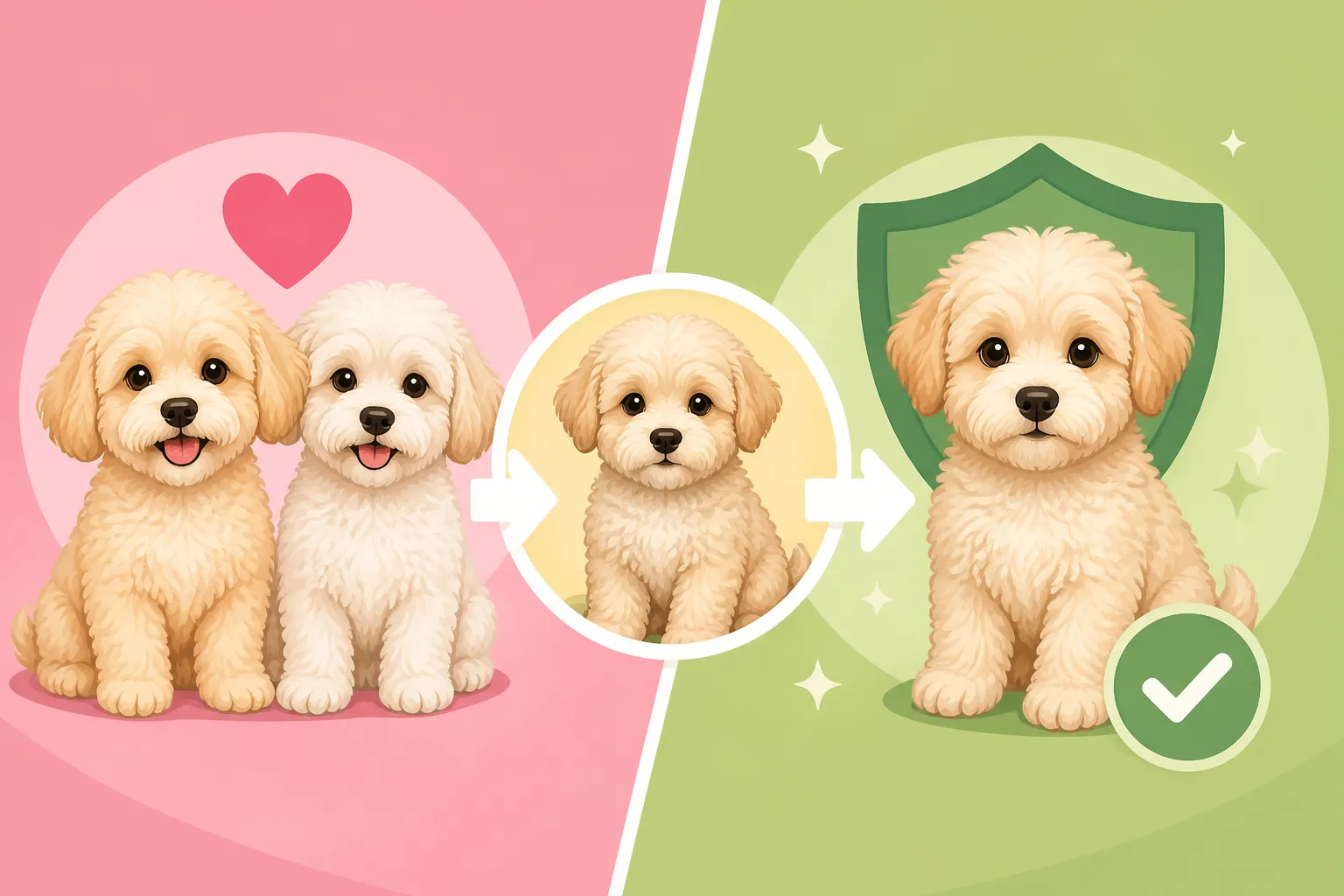
An F2 Maltipoo is the product of breeding two F1 Maltipoos together (Maltipoo x Maltipoo). This is where the idea of "steadiness" or increased predictability often comes into play, but it's a common misconception. Many people assume that by breeding two dogs of the same crossbreed, you somehow stabilize the traits and get a more consistent outcome. Unfortunately, canine genetics don't work that way. Instead of creating more stability, breeding two F1 Maltipoos can actually increase the variability in the litter.
Imagine you have two bowls, each containing a mix of different colored beads (representing genes) from both the Maltese and the Poodle. When you breed an F1 to an F1, you're essentially taking a random scoop of beads from each bowl and mixing them. The resulting F2 puppy can inherit any combination of these beads. This means that a puppy might end up with a high percentage of Poodle traits, or a high percentage of Maltese traits, or anything in between, even if both parents are F1 Maltipoos that look and act very similarly. Hidden recessive genes from either original purebred parent can suddenly pop up, leading to unexpected coat types, sizes, or indeed, temperaments. This makes predicting the F2 generation often less predictable than the F1b, and sometimes even less so than the F1, as the genetic lottery has had another round of shuffling.
Temperament: The Illusion of Steadiness in F2 Maltipoos
The desire for a "steady" or predictable temperament in a Maltipoo is perfectly natural. You want to know what you're getting, especially when bringing a new puppy into a busy household. However, the notion that an F2 Maltipoo automatically offers this steadiness is largely an illusion based on a misunderstanding of how crossbreed genetics unfold.
The Myth of "Stabilized" Traits
One of the biggest myths surrounding F2 Maltipoos is that breeding two Maltipoos together somehow "stabilizes" their traits. The logic often goes: if the parents are both Maltipoos and have desirable characteristics, then their offspring must surely inherit those same desirable characteristics consistently. This is a tempting idea, but it's not accurate for hybrid breeds. When you breed two F1 Maltipoos, you are essentially breeding two hybrids, not two purebreds with a long history of consistent trait expression. Purebreds have generations of selective breeding to solidify their characteristics, but F1 Maltipoos are still a fresh mix.
Because each F1 parent carries a diverse mix of Maltese and Poodle genes, the combinations that can emerge in an F2 litter are incredibly varied. There's no genetic mechanism that automatically "locks in" specific traits just because both parents are F1s. Instead, you get a further reshuffling of the genetic deck. A puppy might inherit a dominant gene for a calm demeanor from one F1 parent and a recessive gene for high energy from the other, leading to a puppy that is quite different from either of its F1 parents. The idea that F2s are inherently "steadier" in temperament is a dream, not a genetic reality.
Why Variability Can Increase in Later Generations
It might sound counterintuitive, but the genetic variability can actually increase in later generations of crossbreeds like the F2 Maltipoo. In an F1 cross, the parents are two distinct purebreds. In an F2 cross, both parents are already a mix. This means that all the recessive genes from both the original Maltese and Poodle lines, which might have been hidden in the F1 parents, now have a chance to combine and express themselves in the F2 offspring.
For example, imagine both F1 Maltipoo parents carry a recessive gene for a certain coat type or energy level that isn't evident in them because they also inherited a dominant gene masking it. When these two F1 parents breed, there's a chance their F2 puppies could inherit two copies of that recessive gene, resulting in a completely unexpected trait. You might see an F2 litter with puppies displaying a wider range of temperaments, activity levels, or even physical traits like coat texture, than what you saw in the F1 generation. This makes predicting an F2 puppy's exact personality a significant challenge. Some might be laid-back, others quite spirited, and it's all part of the genetic lottery.
More Predictable for Some, More Variable for Others
While the overall genetic variability remains high in F2 Maltipoos, it's also true that on an individual basis, some F2 puppies might happen to inherit a combination of genes that makes them seem particularly "steady" or consistent. This isn't because the F2 generation is inherently more predictable, but rather because chance sometimes smiles upon us. A puppy might luck out and get a perfect blend of biddability and sweetness. However, this is not a rule that applies to the entire generation or even an entire litter.
For every F2 puppy that exhibits a wonderfully calm and consistent demeanor, there might be a littermate that is surprisingly high-strung, incredibly stubborn, or prone to excessive barking. This is the reality of breeding hybrids beyond the first generation. It’s important for prospective owners to understand that selecting an F2 Maltipoo isn't a shortcut to a guaranteed temperament. You still need to approach the selection process with the understanding that each puppy is an individual, and the generational label isn't a foolproof predictor of their future personality.
| Generation | Parentage | Expected Temperament Predictability | General Characteristics |
|---|---|---|---|
| F1 Maltipoo | Purebred Maltese x Purebred Poodle | Low to Moderate | Highly variable, can lean towards either parent. Energetic or calm, biddable or stubborn. |
| F1b Maltipoo | F1 Maltipoo x Purebred Poodle (or Maltese) | Moderate (some traits) | Slightly more predictable in traits leaning towards the backcross parent (e.g., curlier coat with Poodle backcross). Temperament still varied. |
| F2 Maltipoo | F1 Maltipoo x F1 Maltipoo | Low | High variability due to further genetic recombination. Recessive traits from original purebreds can emerge. No inherent "steadiness." |
Beyond Generation: Factors That Truly Influence a Maltipoo's Temperament
While it's easy to get caught up in the allure of generational labels, the truth is that a Maltipoo's temperament is shaped by a much broader set of influences than just whether they are an F1, F1b, or F2. Many of these factors are within your control as an owner, offering a far more reliable path to a well-adjusted, "steady" companion.
The Crucial Role of Early Socialization
Perhaps one of the most impactful determinants of a Maltipoo's temperament is proper early socialization. A puppy's brain is like a sponge during its critical developmental period (roughly 3 to 16 weeks of age), absorbing every experience. Exposing your Maltipoo puppy to a wide variety of sights, sounds, people, and other friendly, vaccinated dogs during this time is absolutely vital. This isn't just about fun playdates; it's about building confidence and resilience.
A well-socialized Maltipoo is far more likely to be calm, friendly, and adaptable, even if their genetic predisposition leans towards nervousness or shyness. Conversely, even a genetically "steady" puppy can become fearful or reactive if they are not properly socialized. This means gently introducing them to different environments, from bustling park paths to quiet living rooms, ensuring positive experiences with children (if you have them), and teaching them that the world is a safe and interesting place. A lack of early exposure can lead to a dog that's easily overwhelmed, fearful of strangers, or prone to barking at novel stimuli, regardless of its F-generation. Thinking about The First Days With a Maltipoo Puppy and getting this right from the start is paramount.
Training, Consistency, and Routine
Once your Maltipoo puppy is home, consistent training and a predictable routine become your most powerful tools for shaping their temperament. Maltipoos are intelligent dogs, particularly with their Poodle lineage, and they thrive on structure and clear communication. Establishing routines for feeding, potty breaks, playtime, and sleep helps them feel secure and understand what's expected of them. Consistent positive reinforcement training not only teaches them commands but also builds their confidence and strengthens your bond.
Without consistent training, even the smartest Maltipoo can develop undesirable behaviors simply because they haven't been taught otherwise. For example, if a Maltipoo isn't taught appropriate greeting behaviors, they might jump on guests. If they don't have a solid understanding of basic cues like "sit" or "stay," they might seem unruly or "unsteady." Resources like BAXTER & Bella's online puppy school can provide invaluable guidance and a structured approach to ensure you're consistent, which is key. They often highlight how vital consistency is in helping a puppy learn and feel secure. This commitment to training from day one is far more influential than any generational label. Remember, What a Maltipoo Should Know by Six Months is a direct result of your dedication to training.
Breeder Practices and Parental Temperament
Before you even bring a puppy home, the practices of the breeder play an enormous role in the puppy's eventual temperament and health. A reputable breeder prioritizes health testing for both parent dogs – Maltese and Poodle for an F1, or the F1 Maltipoos themselves for an F2 – to ensure they are free from inheritable conditions that could impact their quality of life. But beyond health, a good breeder also carefully assesses the temperament of the parent dogs. They should be calm, friendly, and well-adjusted. If the parent dogs are nervous, aggressive, or overly shy, there's a higher chance their puppies will inherit similar predispositions, regardless of whether they are F1, F1b, or F2.
Furthermore, a responsible breeder will provide an enriching environment for the puppies during their first few weeks of life, introducing them to gentle handling, different sounds, and appropriate stimulation. This early exposure, even before they come to your home, contributes significantly to a puppy's confidence. Always ask a breeder about The Four Certificates a Maltipoo Breeder Should Show and don't hesitate to ask What to Ask a Maltipoo Breeder Before Paying to ensure you're getting a puppy from a responsible source. A breeder focused on health and temperament in their breeding lines will consistently produce more stable puppies than one who simply breeds for profit, regardless of the 'F' generation.
Setting Realistic Expectations for Your Maltipoo
Bringing a Maltipoo into your life is an exciting journey, and it’s important to embark on it with realistic expectations. While the idea of a "steadier" F2 Maltipoo might be appealing, focusing on factors you can control, and appreciating the unique qualities of your individual dog, will lead to a far more fulfilling experience.
Embracing the Unique Blend
Every Maltipoo, whether F1, F1b, or F2, is a unique blend of two distinct and wonderful breeds: the Maltese and the Poodle. This blend is what makes them so special, bringing together the Maltese's affectionate nature with the Poodle's intelligence and vivacity. Instead of seeking genetic "steadiness" through generational labels, embrace the delightful surprise that comes with a crossbreed. Your Maltipoo will have its own individual personality, a charming mix of traits that makes them truly one-of-a-kind.
Understanding that variability is inherent in hybrid breeds allows you to appreciate the specific quirks and characteristics of your dog rather than expecting them to fit a predefined mold. Some might be more playful, others more reserved; some might be quick learners, others might require a bit more patience, perhaps even displaying the characteristic "stubborn streak" that can come from the Maltese side. Being open to their individual personality is the first step in building a strong, loving relationship.
What to Prioritize When Choosing a Maltipoo Puppy
When you're choosing a Maltipoo puppy, put less emphasis on the F-generation number and more on these critical factors:
- Reputable Breeder: Seek out a breeder who is transparent about their practices, performs health screenings on parent dogs, and raises puppies in a clean, stimulating home environment. They should be able to tell you about the temperaments of both parents and how the puppies are being socialized.
- Parental Temperament: Observe the mother (and ideally the father, or at least have a clear description of his temperament). Are they friendly, calm, and outgoing? Good parent temperaments are a strong indicator of good puppy temperaments.
- Individual Puppy's Temperament: Spend time with the puppies. Look for a puppy that is curious, friendly, and comfortable being handled. Avoid puppies that are overly shy, fearful, or aggressive. While a very young puppy's personality is still developing, you can get a good sense of their innate disposition.
- Health Clearances: Ensure the breeder provides health clearances for both parent dogs, checking for common issues like Slipping Kneecaps in a Maltipoo or The Liver Shunt a Maltipoo Can Inherit From the Maltese. This ensures you're bringing home a puppy with the best possible start to a healthy life.
These considerations provide a much more reliable foundation for finding a well-adjusted companion than simply relying on an F2 label.
Preparing for the Unpredictable, Training for the Best
Even with the most careful selection, bringing a Maltipoo puppy home means preparing for a journey that will have its ups and downs. Every puppy presents challenges, and some Maltipoos, particularly those inheriting a stronger Maltese stubbornness, might be Why Housetraining a Maltipoo Takes Longer Than You Expect. You might find yourself wondering How Many Months Before a Maltipoo Stops Having Accidents. It's crucial to acknowledge that perfection isn't the goal, but rather progress and a strong, positive relationship built on trust.
Invest in high-quality training resources, whether it's local puppy classes, online programs like BAXTER & Bella, or comprehensive guides available on Amazon. Consistency, patience, and positive reinforcement are your greatest allies. Understand that your Maltipoo is a sensitive creature; they typically respond best to gentle, reward-based methods, as they can be Whether a Maltipoo Is Too Soft for Correction. Providing a stable, loving environment, continuing their socialization, and committing to ongoing training will mitigate much of the genetic "unpredictability" and help your Maltipoo grow into a confident, loving, and truly steady companion, regardless of their generational background. Even if your home is a bit lively, understanding Whether a Maltipoo Copes in a Loud House can help you adapt and support your dog.
Disclaimer
This article is for general informational purposes only and does not constitute professional advice. Laws, prices and regulations vary by location and change over time. Consult a qualified professional for guidance on your specific situation.